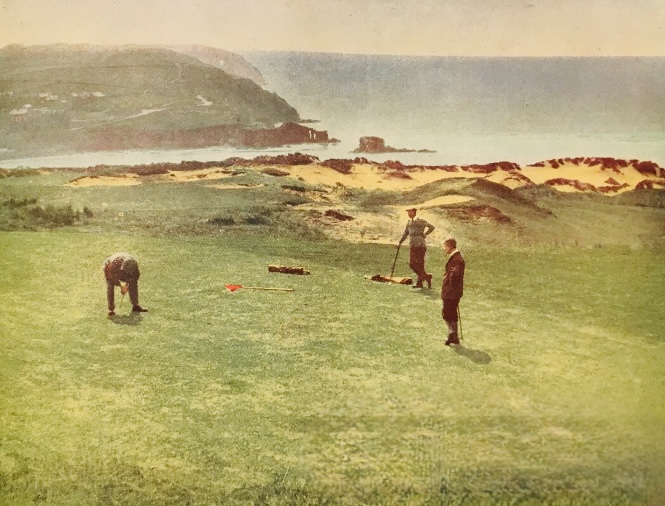
Preface
Skrifer Istori
It seems perfectly appropriate that the first two words of this account of the early story of golf at Perranporth — the place where our patron saint, St Piran, is said to have landed — should be Cornish. Not a common greeting such as Dydh da, but the words Skrifer Istori, meaning “history writer”: the Bardic name of our author, Tony Mansell.
Tony’s History of Perranporth Golf Club (2014) was researched and written in a remarkably short space of time and tells a comprehensive and compelling story of the club. He has kindly agreed that his text may be reproduced here.
Golf had long been played upon the miles of glorious golden sand along Cornwall’s north coast. In April 1926 — months before our story begins — the Western Morning News reported, under the heading “Perranporth, A Veritable Paradise”:
“Then on the sands… men and women go along swinging clubs at golf balls without interfering in any way with the other games, so expansive is the area available.”
It was perhaps no surprise that the game would eventually venture onto the Towans.
I have brought the narrative to the moment when the club rose again after the Second World War. If you are fortunate, you may come across a printed copy of Tony’s book, where the remainder of the tale is told. If you do, keep it safe — our grandchildren — the Jacks and Jennys — will need to know. Otherwise, seek out a good Cornish library, or Kresen Kernow, the archive centre in Redruth.
Introduction
As you wait for the four-ball up ahead to move out of range, take a moment to think of those who have gone before. Not the golfers of the past who have pitted their skills against this formidable course but the generations of miners who have laboured here to eke out a living by scraping metals from the bowels of the earth. They climbed the steep hill from Perranporth or wandered in from the other villages, and before they descended into the darkness to rip the precious minerals from the rock face they must have wondered whether it was their turn to fall victim to some underground tragedy.
Perhaps it was their womenfolk who worked as bal maidens on the surface, the women and girls who broke the ore to feed the hungry stamps. We do not know whether they were provided with some rudimentary cover against the Atlantic storms or worked with the sky as their ceiling but one thing is certain, the inhospitable terrain of Reen Sands must have resounded to the sound of metal on stone. No doubt their minds wandered to more pleasant thoughts as they wielded their heavy hammers but never in their wildest dreams would they have imagined that their workplace would one day be put to its present use.
Those up ahead have moved on but before you drive off, cast a glance to the west, across Ligger Bay, to the lonely vigil of Cow and Calf. It is a clear day so it must be fit for golf. Of course, it is rare that blustery wind or rain will ever prevent play at Perranporth: not as far as the course is concerned.
This is the story of a golf club and its battle against the odds, its efforts to overcome physical obstacles like creating a course out of a windswept, desolate mine dump and its continual fight with the wildlife aggrieved at the invasion of its habitat, but most of all it is about its struggle to find a solution to its financial problems. It is a story of perseverance and of brave decisions taken at critical points in its life, living proof that tenacity does win through.
You will find that this book does not contain the usual lists of winners of this or winners of that on the domestic front – I have seen no need to fill its pages with information which is adequately displayed in the clubhouse. I hope that will not be a disappointment and that you will take as much pleasure from reading the history of Perranporth Golf Club as I have from researching and writing about it.
Men of Vision
In September 1926 Perranporth Estates Company Ltd purchased the extensive dunes known as Reen Sands, an area lashed by the elements and littered with mining remains. The ancient workings of Wheal Vlow, Wheal Leisure, Ramoth and Budnick surround the area and the “old men’s workings” reach out like tentacles to undermine every corner of the site.
Uncharted levels that date back hundreds of years weave in every direction and rise and fall like the waves of the sea. Last worked during the 1830s, the area became an attractive target for halvaners in the early 1900s as they rummaged amongst the overburden to find any trace of tin missed by the early miners.
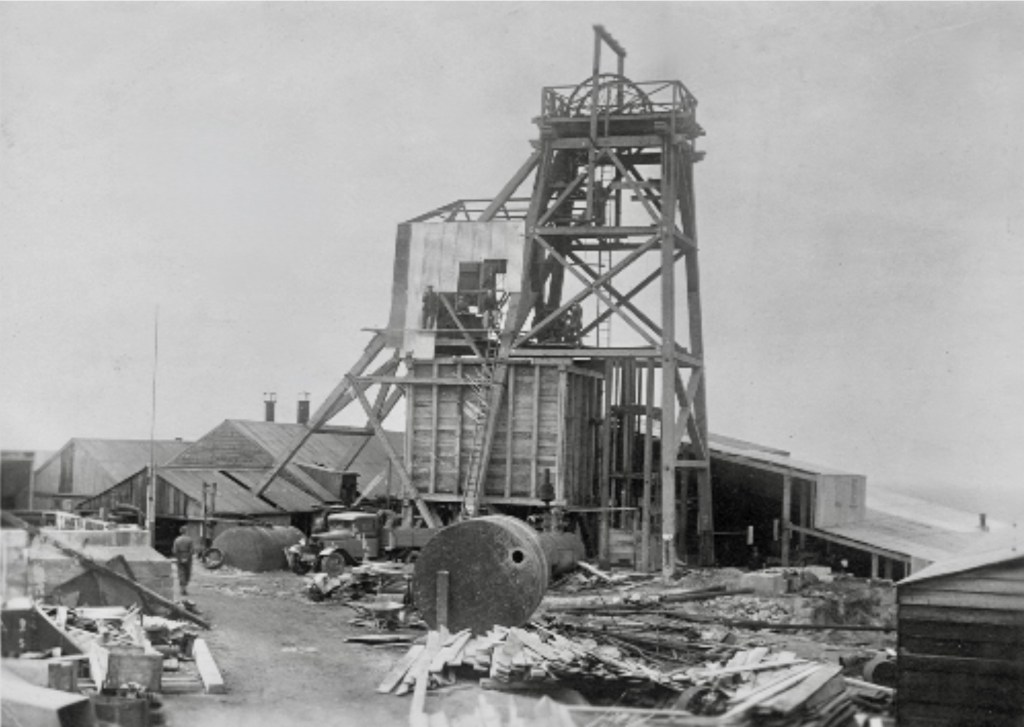
Some of the company’s directors were Perranporth men whose interests went beyond the commercial nature of their acquisition, men who had the vision to see this sand-strewn wasteland as an ideal location for a golf course. The miners had unwittingly created a site of far more interest and at far less cost than they could ever achieve, with its array of natural bunkers and hazards. Perhaps, as these men surveyed the scene, straining against the wind, they visualised the grass-covered fairways and greens of a fine sporting course. It would take a considerable amount of hard work but it could be done.
About 150 people attended a public meeting on the 27th August 1926 when there was a single item on the agenda – to consider the formation of a golf club. Dr A Fuller Snr, Mrs Whitty, Mr Dippie of Redruth, Mr Wilson of Coventry, Mr Healey and Mr Leeming had convened the meeting, and now Dr Fuller took the chair and explained that the syndicate had put forward terms on which it was prepared to grant a 21-year lease of a sufficient area of land to enable a golf course to be laid out. It was probable that the lease would be renewed when the initial period had expired but no assurances had been given regarding this.
Offers of financial support had already been received and he was confident that sufficient bonds would be taken up to make the venture possible. Perranporth Estates (the syndicate) would be the landlord and would lease the land to a new members’ organisation which would construct and run the golf club. He concluded by saying that the possibility of building a golf club at Perranporth had often been discussed and that those present now had the power to turn that hope into reality. The message was enthusiastically received and when the moment came for a show of hands the decision was unanimous. It was the mandate they wanted – one step on a very long road, but an important one.
An organising committee was formed. It comprised Dr Fuller, Dr Briscoe, Mrs Whitty, Mr Wilson, Mr Leeming, Mr Dippie, Mr Healey, Captain Thomas (honorary secretary), Mr Clark, Mr Trebilcock, Mr Welsh and Mr Marshall. No doubt the possibility of a conflict of
interest was thought of if not mentioned as at least two members were also directors of Perranporth Estates.
At Perranporth, the natural conditions are ideal for golf. The promoters of the scheme are doing a service to Cornwall as well as to Perranporth and themselves.
— West Briton, September 1926
The organising committee wasted no time: it met the following day. Mr Wilson outlined the terms of the lease which his company was prepared to offer. The rent for the first four years would be £25, £50, £75 and £100 a year, and for the 5th to the 14th year inclusive it would be £100 a year plus 10% of the green fees. For the 15th to the 21st year inclusive it would rise to £200 a year plus 10% of the green fees.
Echoing the concerns of the public meeting the members were anxious that there should be a continuance beyond the period of the lease. After all, the cost and effort of building the course was going to be considerable and they wanted to ensure that it would not be lost after a couple of decades. With one foot in each camp Mr Wilson understood this and promised to recommend to his fellow directors that a clause should be included whereby the club would have the option to purchase the freehold of the site at any time between the 14th and the 21st year. He could not guarantee their agreement but the committee was reassured by his comments and agreed to recommend the terms to the financial bond-holders.
Within a short while the lease arrived and the committee gathered to hear the details. Most were in accordance with Mr Wilson’s presentation but there was a sting in the tail, in that the syndicate could not agree to lengthen the term of the lease nor would it include an option for the purchase of the freehold. This must have been hugely disappointing but, surprisingly, little seems to have been made of it and I can only assume that it was considered to be an issue which would be resolved in due course. Members received the assurance that none of them would be financially liable and, notwithstanding the limitation on the lease period, they agreed to recommend acceptance to the bond-holders.
There was considerable local interest in the project and the officers were pleased to record that financial bonds were “freely coming in”. News of the venture had also spread throughout Cornwall, prompting James Henry Hearn of Bodmin to offer his services as the club professional. With the legal issues resolved, the committee turned its attention to the practicalities of creating a golf course from what must have seemed like a bomb site. Help was needed and the club sought advice from a much-respected local amateur golfer, Mr T Knowles. His reputation made him the ideal person to approach.
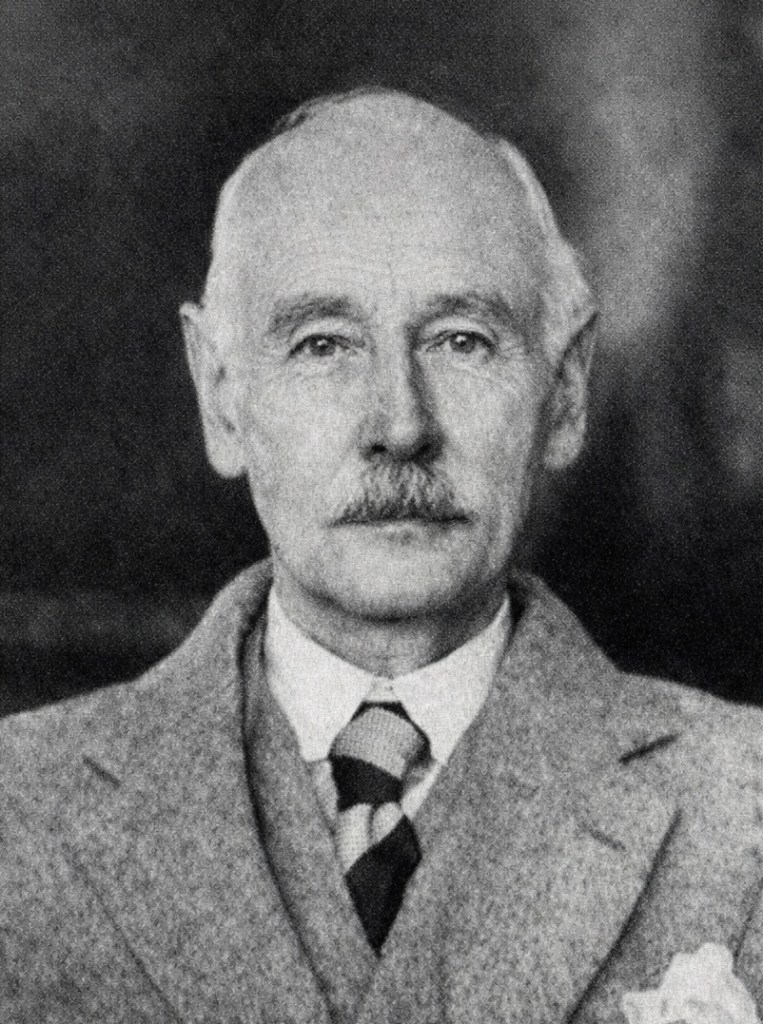
Cornish Golfer: Thomas Knowles was one of the most influential figures in Cornish golf in the early twentieth century. A Lancastrian by birth, he became the Secretary at the Camborne School of Mines and remained in Cornwall for the rest of his life, eventually advancing to Vice-Principal of the College. He initially lived in central Camborne before later moving to Lelant.
In 1904 he was a member of West Cornwall’s winning County A Team. He served as Captain of the club in 1907 and 1908 and remained a committee member until 1935. He was one of the county’s finest amateur golfer of his generation. Of wiry build, his golf game was built on precision rather than strength. His handicap in 1907 was +3, and he long held the amateur course record at Lelant.
There seems to have been abundant enthusiasm for the scheme, with every difficulty being addressed in a positive manner, but there was one aspect that was difficult to resolve. It was a problem that would return time and again during the life of the club: how to get rid of the rabbits. After all, it had been their home from time immemorial and the occasional sign was unlikely to convince them that they should leave. Undaunted, the committee suggested rabbit-proof fencing, presumably to the perimeter of the site. Perhaps it should have occurred to the businessmen that to enclose an area the size of a golf course was going to cost considerably more money than was available, but this did not stop them from pressing ahead with their plans.
While they waited to hear whether Mr Knowles was willing to be involved, the committee approached Mr R H Watts, turf expert of Sutton & Sons, for an opinion on how to turn the rough, barren land into a surface fit for golf. He seems to have accepted the challenge and quickly produced his recommendations.
Report of an Inspection of the Site for the Proposed New Golf Course at Perranporth
From a purely architectural standpoint it is impossible to feel other than complete satisfaction with the site for the proposed new golf course at Perranporth. The conformation of the land, character of the indigenous herbage and the abundance of natural hazards, are factors which should materially contribute to the creation of a really first-class links and there is no reason why Perranporth should not eventually take a place in the front rank of English courses. In many cases excellent natural sites for the greens exist and the amount of actual construction work should not be considerable. On the ground in question there is in fact every possibility of laying out an attractive set of 18 holes at quite a minimum outlay. A considerable supply of soil is necessary, especially for the greens. It needs to be a minimum of four inches deep and for an area of, at least, 20 yards · 20 yards, or even 20 yards x 30 yards for each green.
The news from Mr Knowles was good: he had agreed to become involved. He had viewed the site and on the 7th September 1926 he delivered his recommendations. He began by saying that he considered the site to be extremely suitable for a well-planned course, an opinion which must have brought sighs of relief from the organising committee. He felt that the holes should be provisionally pegged out and then an expert, such as James Braid, asked to confirm or amend the layout. Considering the terrain of the site, advantage should be taken of the large valleys and of the contour of the rougher ground, but the levelling or reducing of a few hillocks might be advisable. The committee was delighted and immediately agreed to implement his recommendations.
Cornish Golfer: An anecdote preserved in the Trevithick Society Newsletter (Spring 2017) gives a glimpse of Knowles’ presence at the Camborne School of Mines. During an illustrated lecture, delivered on a warm afternoon with the blinds drawn, a student — recently returned from the War and something of a character — had smuggled a donkey into the rear of the theatre. Twenty minutes into the talk, the animal announced itself with a loud “hee-haw.” Knowles calmly raised a blind, took in the situation, and is said to have remarked to the owner: “I think your friend has lost interest in the subject matter of this lecture — perhaps you should return him to the field.” It is a small story, but it confirms the impression of a man of authority, unflustered and entirely in command of his room.
Letter to Members and Bond-holders – September 1926
The committee appointed at the public meeting held recently to consider preliminary steps to be taken to form a golf club at Perranporth have now considered the terms of the lease offered by Perranporth Estates Co Ltd to the club. They have taken legal advice on this and now report that the terms of the lease are fair and recommend that they be accepted. The organising committee are of the opinion that the sum of at least £2,000 will be required to lay out the course, but they think it advisable to ask for the support of £3,000.
[The letter included reports from both Sutton & Sons and Mr T Knowles.]
This being so we shall be glad to receive an application from you for membership and also to have your attendance at the first meeting of the club members and bondholders to be held at the Women’s Institute, Perranporth, on Thursday 7th October 1926 at 3.30pm for the purpose of appointing trustees, committee officers etc., and at the meeting the club will elect its first committee, so that it is very desirable that as many intending members as possible should make it convenient to attend.
Applications are also asked for 5% bonds at £5 each, two of which will give a right to the holder, so long as he remains a member of the club, to pay the original annual subscription.
The bonds will be transferable but any purchaser will only be able to become a member of the club after election in the usual manner.
Andrew Fuller, Chairman
W Thomas, honorary secretary
K Leeming, acting honorary secretary.
A Club is Formed
On the 7th October 1926 about 50 prospective bond-holders and members gathered to hear what progress had been made. The situation with the lease was explained but the period had changed to 28 years. (Either this was an error or it was the originally stated 21 years plus an option of a further seven years.)
We can assume that the members approved of what had happened so far, as the meeting then moved to consider the three proposals on the agenda: the acceptance of the draft lease, the formation of Perranporth Golf Club and the election of members from those who had submitted application forms. All three matters were passed.
The organising committee had been formed to deal with the preliminary aspects of setting up a golf club and now, with that objective achieved, it was disbanded. In its place would be a new Perranporth Golf Club committee. An invitation was issued to the Right Honourable Viscount Lord Falmouth to become the first president and, in due course, he accepted and invested £100 in bonds. T H Williams of Barclays Bank, Truro, was elected honorary treasurer and Captain William Thomas of Perranporth the honorary secretary. Fred Healey of Perranporth, Dr Andrew Fuller Snr of Perranporth, W Dippie of Redruth, Trevor Robinson of Perranporth, L Grafton Bird of Truro, H L Wilson of Warwicks., Oscar Blackford of Truro and Captain K I F Leeming of Perranporth were to serve as members of the new committee.
The first committee meeting followed immediately, with Fred Healey in the chair. The agenda must have been packed with pressing items but, golf being golf, a set of rules was considered to be a priority. Fred Healey, Captain Leeming, Trevor Robinson and William Thomas formed a sub-committee and were tasked with producing a draft. The honorary secretary was called upon to advertise for a club professional. He was also to contact James Braid to ask whether he would be prepared to come to Perranporth to design the course. The subsequent response from James Braid was positive.
Cornish Golfer: On 21st October 1926 the Western Morning News reported on Perranporth’s New Club:
“Arrangements have been made for Jas. Braid, the famous professional, to visit Perranporth the first week in November for the purpose of reporting on the site and finally staking the course on the sandhills. Instructions have been given to complete the lease at once, the term being for 21 years with an option for a further seven years. The committee have limited the amount of bonds to be issued at present to £3000.”
A firm financial footing was essential and it was agreed to issue a maximum of 600 bonds priced at £5 each which, if all taken up, would provide a working capital of £3,000. The interest on the bonds was set at 5% and members holding two or more would have their subscription pegged at two guineas (£2.10). It was also agreed that those who had applied for membership before the 31st October 1926 would be excused the one guinea entrance fee.
Within a short while 119 membership applications had been received with a further 23 on the provisional list. Trustees were appointed and the committee were told that a draft set of rules would soon be available for consideration.
Three applications were received for the position of club professional and when James Braid eventually appeared on the scene his opinion was sought as to who should be appointed. It was James Hearn, the man who had first shown an interest, who was offered the position of club professional/greenkeeper. He was to be paid £2 a week “plus facilities for house accommodation” and Mr Dawe was to be approached about his “bungalow over the cliffs”.
Cornish Golfer: The Hearn family formed one of the great professional dynasties in Cornish golf from the closing years of the nineteenth century onwards. Originating in North Devon, no fewer than ten members of the family were listed at the Northam Artisans Club in 1907. In the decades that followed, the Hearns became woven into the fabric of the Cornish game, serving as professionals at Bude, Launceston, Looe, Perranporth, Royal Cornwall, St Austell, Saltash, and Tintagel — at least six Hearns across eight clubs. Nor was their influence confined to the Duchy: members of the family carried their craft far beyond Cornwall, taking up posts at clubs throughout Britain and America.
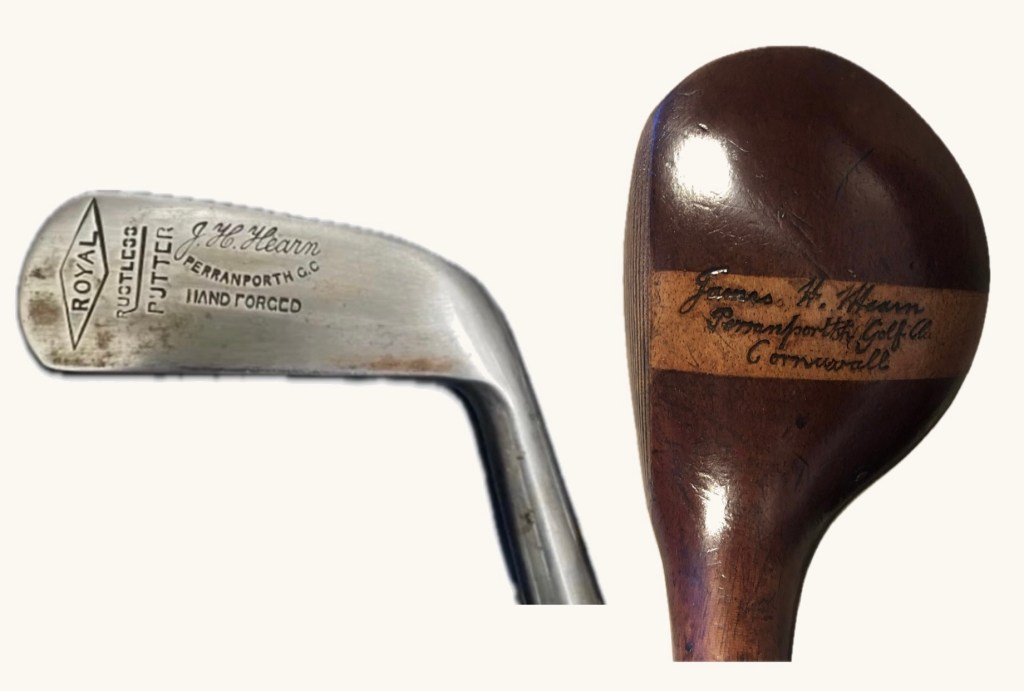
The construction committee first met on the 4th November 1926. Its initial task was to “Wire Hearn to instruct him to take up his duties on the following Monday morning”. Construction work started immediately, with six men at the outset. Six more were taken on 10 within a few days and others were to be employed as and when required. The wages were 9d (3.75p) an hour for the men and 25 shillings (£1.25) a week for youngsters. An order was placed with HTP Ltd of Truro for six hooks and hone-stones, three barrows, three buckets, two forks, two rakes and two turf-cutters, and Mr Healey was asked to construct a wooden tool-house. It was to be 12 ft x 10 ft and to be so constructed as to serve as a shelter on the course when no longer needed for construction work.
Planning the Course
It was Mr Knowles who provisionally staked out the 18-hole course, on the 16th October 1926. He and the committee walked the site and by the time they returned they had a clear idea of the layout. The embryonic course was no longer limited to pieces of paper or to people’s imagination.
Cornish Golfer: In his chapter on Golf in Cornwall in Cornwall: England’s Riviera (1925), Thomas Knowles — describing himself as a “golfer-journalist” — wrote about the golf courses existing at that time in the Duchy. One of those, the new course at Tehidy, he referred to as “the course laid out under guidance of Mr Jim Barnes, the ex-champion of American golf.” Knowles would have known Barnes well from their days together at Lelant before Barnes left for America.
A contemporary newspaper report records that during a joint visit to Tehidy in 1922 — when Barnes was the reigning U.S. Open Champion and already a course designer in his own right — Knowles suggested naming one of the holes “The Barnes Hole.”
“Don’t call it the ‘Barnes Hole’,” said Jim. “Call one ‘Long Jim.’”
What Knowles did not say was that he himself had laid out the Tehidy course. By the time the Perranporth opportunity arose, he was already an established amateur golf-course architect.
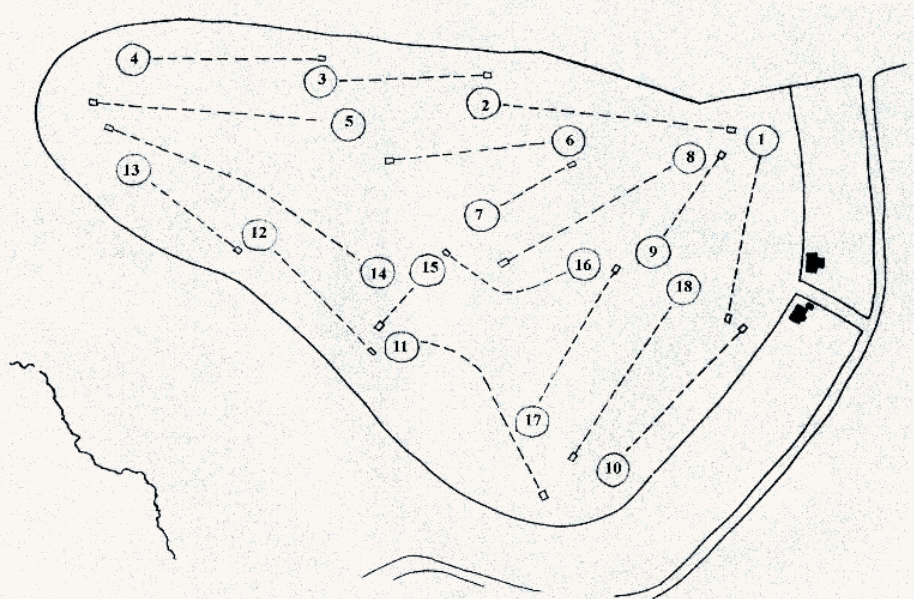
James Braid first visited the site on the 2nd November 1926, accompanied by a Mr J Pitceathley. Braid inspected the course and then met the committee members to deliver his verdict. Even after all this time we can imagine the tension as he began, but it was good news: he was satisfied that the club had a fine site for a first-class course. He said that Mr Knowles had done a splendid job in staking it out, an action which had made his work easier. He saw no need to depart from the general lines suggested, which would provide a course of about 6,000 yards, quite enough he felt, considering local conditions (presumably the terrain). He appreciated that sand dunes were abundant but considered that the walking was not too severe as many of the lines were fairly level, the exceptions being the 11th and 12th holes (current 2nd and 3rd). He felt that if work could begin promptly with a good squad of men arranged in gangs, then playing could begin in June 1927. If temporary greens were used then perhaps the date could be brought forward. Greens had been placed so as to save unnecessary labour and, whilst two or three mounds had to be removed, very little construction work was necessary as “the place lent itself admirably to the laying-out of an excellent course”. Good turf should be used in preference to seeding, 700 to 750 square yards a green, about 2.5 acres in total. It should be two inches thick and set on a one-inch bed of suitable soil, the original top having first been removed. A steam or petrol roller of two to four tons weight would be needed for the fairways. He thought that the total cost of the groundworks would be in the region of £2,000 but an additional amount would be required for tools and a further £400 for seeding, dressing and manure. Only three or four bunkers needed to be formed and work should start by forming the greens and tees. The James Braid fairways should be cut with short scythes and hooks, the stones removed and the area well rolled. A 30-inch mower would be needed and watering should either be “abundantly done or left alone”. Professional involvement during the construction period was advised and Mr Pitceathley was asked to visit from time to time to ensure that the plans were being followed. Mr Knowles’ considerable input was acknowledged and as a gesture of appreciation the club offered him honorary membership.
Work has commenced on the construction of the new golf links at Perranporth on the lines laid down by James Braid, the noted professional. The club has now an enrolled membership of 150.
Western Morning News – 19th November 1926
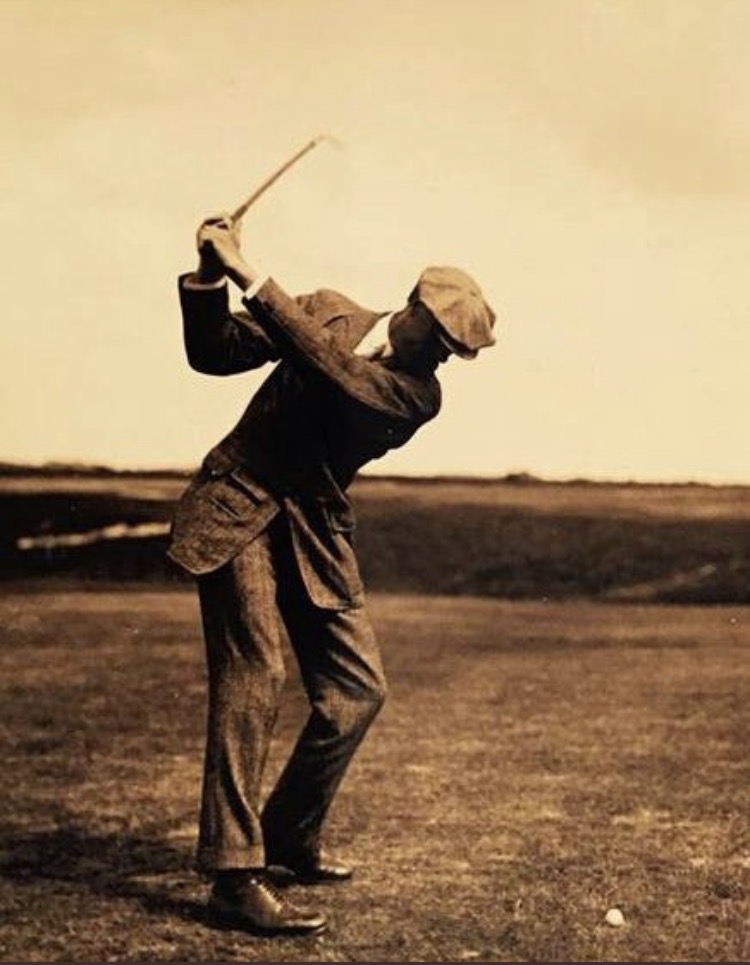
Cornish Golfer: James Braid, one of the Great Triumvirate, first visited Cornwall in 1901 to play a two-day exhibition match at Lelant with J. H. Taylor, the reigning Open Champion. They returned the following year, by which time Braid himself held the title. He would go on to win the Championship five times in ten years, culminating in his Jubilee Open triumph at St Andrews in 1910. Thereafter he became a regular visitor to Cornwall, contributing to the design of St Enodoc (1907), Perranporth and St Austell (1926), Budock Vean (1932), and Truro (1937).
Work Begins
The construction committee met again on the 23rd November 1926 and agreed that “certain selected men, qualified to act as working gangers, would be paid 10d an hour”. A flat-bottomed Ford one-ton lorry with pneumatic tyres was purchased for £145.16.0, lime was obtained for treating the fairways and galvanised sheets were bought to roof the tool- house. Carlyons of St Day and HTP of Truro were asked to quote for the hire of a two- to four-ton self-contained roller. It was also decided to reduce the size of the tees and some greens from that stated in James Braid’s report “so that the completion of the general work can be expedited”. Enlargement would be carried out at a later date. Some heavy plant was necessary for earth-moving, and although the mention of steam shovels and horses and carts sounds primitive by today’s standards it got the job done. At this stage James Hearn was mainly involved in forming the course, but members were keen to hone their playing skills and he was asked to provide golf instruction on Saturday afternoons at two shillings (10p) an hour.
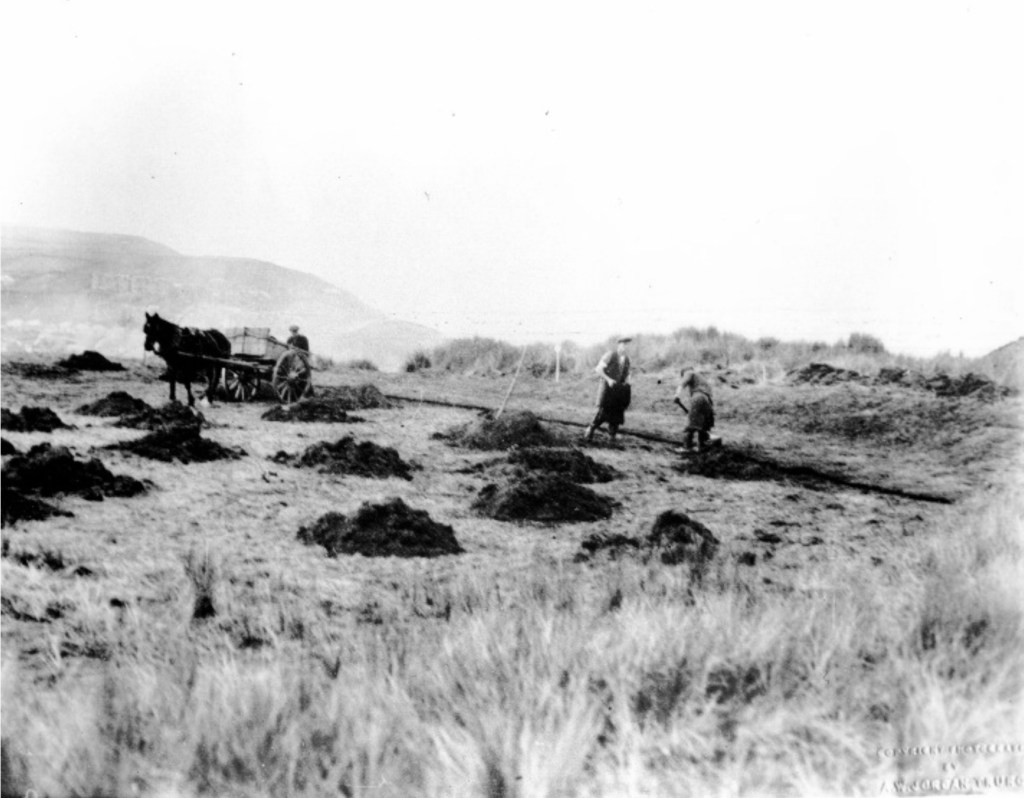
Progress Report – 30th November 1926
Construction work was begun on the 9th November. A convenient tool-house, 12 feet x 10 feet, has been erected and the necessary tools obtained. Greens 1 and 8 have been constructed and are ready for rolling. Tees 2 and 9 are complete. Work is now proceeding on greens 2 and 6 and tees 1 and 7. Thirty men are at present employed. With favourable weather that number of men should complete all greens and tees by the end of January. Nothing has yet been done to the fairways, except that the 1st has been cleared of stones, but work will begin on some of the fairways shortly.
William Thomas, honorary secretary.
(The numbering of tees and greens in this and subsequent reports is based on the original sequence when the round started on the current 10th.)
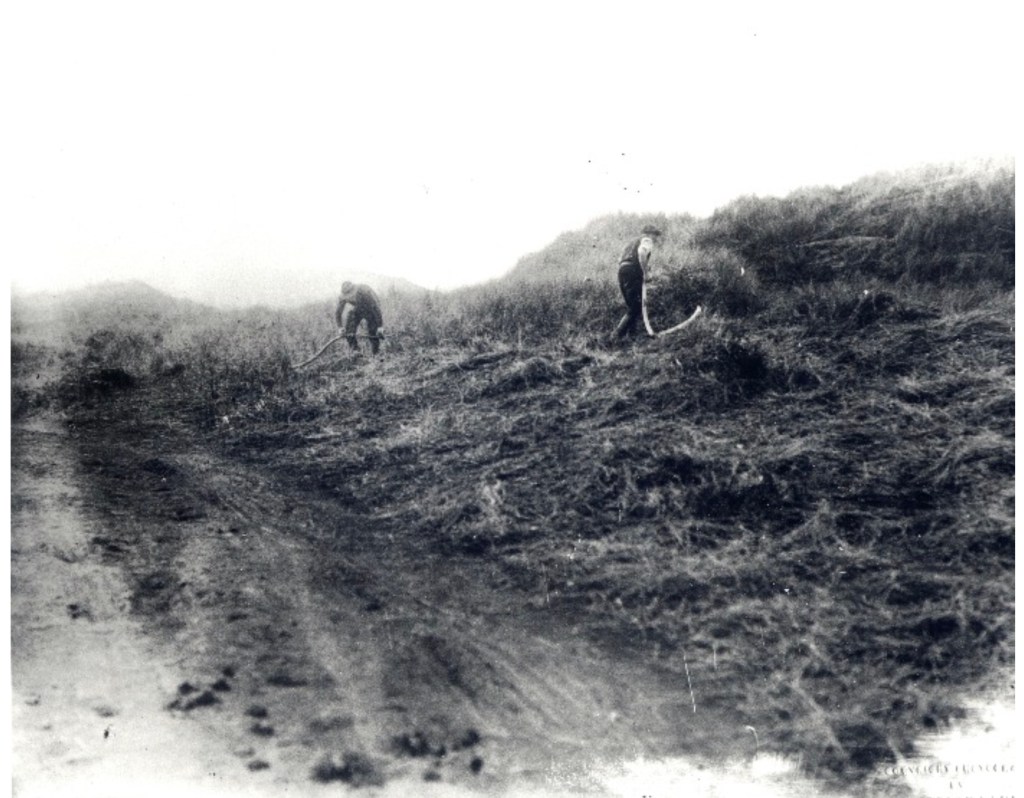
Cornish Golfer: On 24th November 1926 The Cornishman’ reported:
“The course covers about 6,000 yards, and was mapped out by Mr. T. Knowles, B.A., the scratch player of Tehidy and Lelant Clubs; and was revised by Braid, the professional, who found the general plan much to his liking.
Mr. Knowles worked on the line that a hole must be not more than 170 yards, one shot to the green, or less than 300 yards if two shots or more to the green. There were tempting natural greens in hollows, but those would have been inferior to made greens, visible from the tees and justified by the natural trajectory of the balls, and the distance of the green from the tee. It needed imagination to picture the greens on spots covered with vegetation or sand, but as Braid said, you must be prepared to roll a hillock into a hollow or otherwise carry out your architecture in order to get the desired sport.
Mr. Knowles found that while you could not utilise the best bits of turf there was no need of artificial bunkers anywhere, as Nature is lavish with her penalties among the sand dunes. As the 18-hole course has been so carefully planned, it may be expected to be popular both with residents and visitors.”
Progress Report – 20th December 1926
The construction of greens 1, 2, 8, 9, 17 and 18 has been completed and these greens are now being rolled. Work is proceeding upon greens 10 and 16. Tees 1, 2, 9, 10 and 17 are completed and 11 and 18 are ready for turf. Clearing is in hand upon fairways 9, 10, 11, 17 and 18. A continuation of favourable weather will enable us to complete all greens and tees by the end of January.
William Thomas, honorary secretary.
Straying animals were a constant problem, but this had been their home and it was felt that they would move elsewhere as the site became busier. Work was going well, with 30 men employed at a total cost of about £50 a week. Sufficient turf had been acquired for five or six greens and a Mr Robinson had offered an additional supply from a field immediately behind Bolingey Wesleyan Chapel. Mr House had also offered some from the meadow in front of Perranporth Hotel and another source was the dynamite works near the cliffs at Cligga.
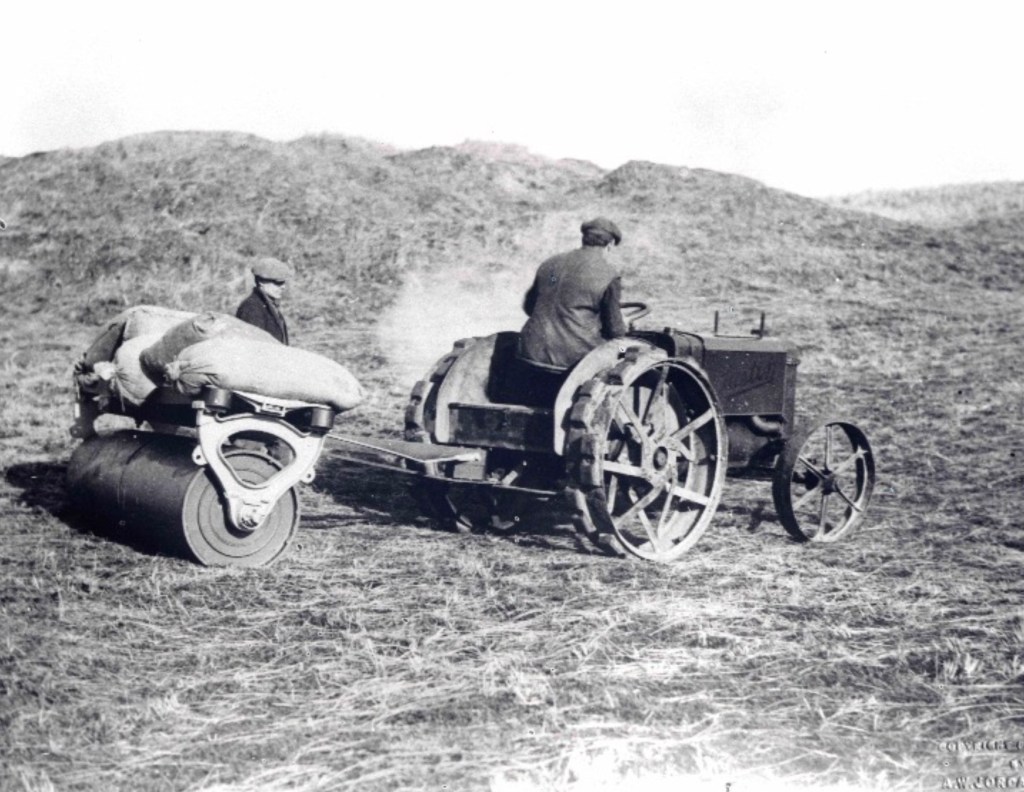
With all this work going on, finances were becoming a bit stretched and there was a general call for additional funds “lest the work already done suffers to a serious extent”. Such a request would become familiar during the early years of the club’s existence.
Appeals had been made to the GWR (Great Western Railway or ‘God’s Wonderful Railway’) the CMT (Cornwall Motor Transport) and the National Transport Company to take up bonds but all had declined. There was also the lingering concern that the course could be lost at the end of the lease period. The desired goal for the members was to own the course, and attempts were still being made to persuade the syndicate to sell the freehold.
To say that rabbits were a problem is an understatement. The erection of a rabbit-proof fence to all the boundaries was still being considered and in January 1927 estimates were being sought. The landlord was also asked for rabbit trapping rights.
Progress Report – 9th February 1927
Thirteen greens have been completed and construction of the remainder is well in hand, turf now being available for the whole. Thirteen tees have been completed. Mowing, rolling and dressing are proceeding on the completed greens and tees. Good progress has been made in clearing some of the fairways. Work will be concentrated on fairways as soon as greens and tees are completed.
William Thomas, honorary secretary.
Letter to Members and Bond-holders – 11th March 1927
Very satisfactory progress continues to be made in construction. The 18 greens and tees are complete and are being dressed and regularly rolled. Work will now chiefly be concentrated on the fairways which will entail considerable labour and expense. Seed for sowing fairways has been obtained from Messrs Sutton & Sons and the advice of their lawn and grass expert, who reported on the links in September last, is being followed. It is anticipated that the course will be in a playable condition by June.
William Thomas, honorary secretary.
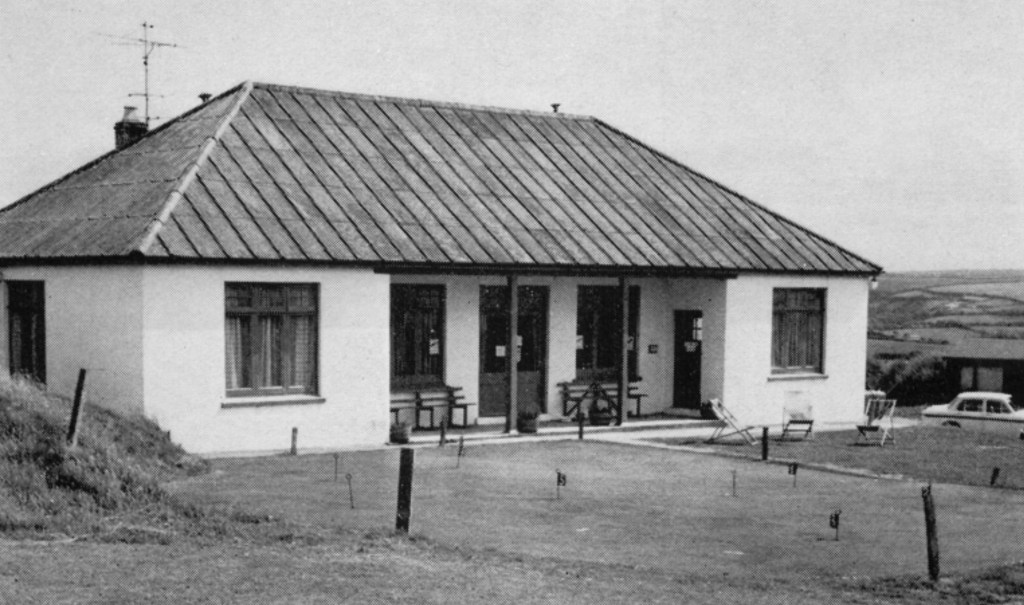
The Clubhouse
A golf club needs a clubhouse but whereas the creation of a course on leased land was acceptable, the committee was understandably reluctant to invest in bricks and mortar on such a fragile tenure. Mr Wilson understood this and agreed to ask his fellow directors whether they would be prepared to provide a freehold site for the building. Additionally, he would ask them to consider the installation of a water supply.
Mr Knowles felt that the clubhouse should be erected in the vicinity of the three-inch telephone poles, immediately south of the gap in the hedge where the path to Rose crosses the main road (presumably near the current 11th tee). He also recommended that the 1st and 18th holes should be close to the clubhouse and the 9th reasonably close. As the plan evolved, the preferred position of the clubhouse moved a little further down the hill. True to his word, Mr Wilson had met with his fellow directors and the club received an offer of a freehold site for a clubhouse. It was to be free of charge on condition that the club made up the entrance road from Budnic Hill and accepted a clause that in the event of the club being wound up, or on termination of the lease, the landlord would be entitled to purchase the clubhouse at valuation. The building would be a combined clubhouse and professional’s accommodation and construction work would proceed as soon as possible.
Progress Report – 30th November 1926
A freehold site for the clubhouse has been presented to the club by the Perranporth Estates Co., Ltd. William Thomas, honorary secretary. By early December 1926, plans had been submitted to Truro Rural District Council and tenders were being invited for the building work. Two were received: one from Menadue & Thomas who quoted £1,690 and the other from Healey & Co which was at the considerably lower figure of £1,250.
Unsurprisingly the lower tender was accepted. Despite the progress, funding was not yet in place, but there was a reference to “the proposed hotel scheme and the possibility of joint buying of liquors which may attract a loan”, so a new hotel was being planned, probably by the syndicate, and presumably at the top of the hill.
Progress Report – 20th December 1926
A contract has been entered into for the erection of a commodious clubhouse and building will begin forthwith.
William Thomas, honorary secretary.
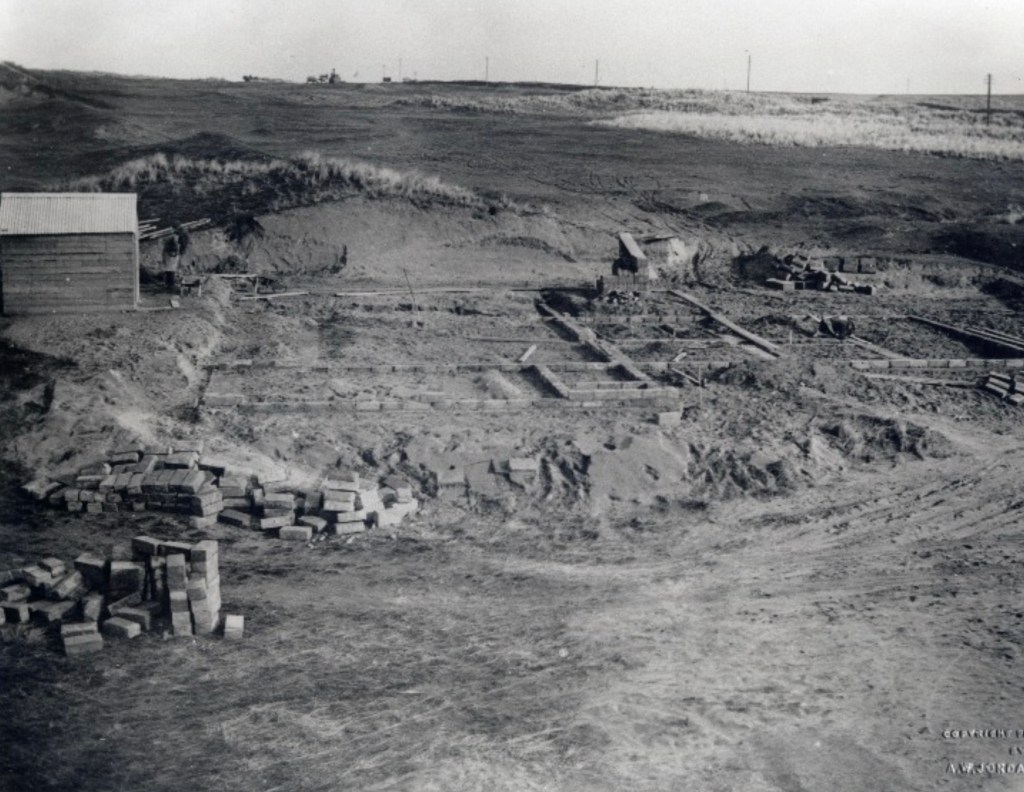
From the progress report of 9th February 1927 we can tell that the foundations had been laid and masons were engaged in building the walls. By the 11th March the walls were almost complete. The clubhouse was progressing well and it looked as though the front portion, the bar area, would be available by May, but the installation of a hot water and heating plant was postponed, presumably until funds were more plentiful.
When half a dozen or so public-spirited men in the autumn of this year made known their plans for development of the sand hill property and the construction of a golf course the sceptics were by no means silent. But the promoters went steadily forward, overcoming opposition and surmounting difficulties until it can be now said that Perranporth Golf Club is actually in being and that play will be taking place about the middle of the coming year. Considering that work was only commenced in November, wonderful progress has been made. The contract has been signed for the construction of a clubhouse. This will consist of a club room, two dressing rooms, a bar and a card room with living accommodation for the professional. Plans have been prepared by the Perranporth Estates Company for a commodious hotel and building developments are expected, so that the founding of Perranporth Golf Club apparently heralds the development in a much wider sense of one of the county’s most charming watering places.
—West Briton, 30th December 1926
In May 1927 an offer by Hicks of St Austell was accepted. The brewery was to lend £1,500 at 5% interest for a mortgage on the proposed clubhouse on condition that all liquors would be purchased from them. The entrance road was being constructed by R Kessell and two men who were “borrowed” from the Perranporth Estates for two or three weeks. It is unclear what is meant by “borrowed”.
The deed of gift for the clubhouse site, signed on the 20th May 1927, was between Perranporth Estates Company Ltd on the first part, Lloyds Bank on the second part and Arthur Treve Holman, Andrew Fuller, William Thomas and Thomas Henry Williams on the third part. These four men represented the golf club and were possibly the first trustees. It seems that arranging a water supply had not been as easy as hoped and a 500-gallon tank was purchased and fitted with a tap, hose and pump so that water could be brought from Goonhavern and stored for use on the greens and in the clubhouse.
A spacious clubhouse has been erected which includes a club and general room 28 feet x 22 feet with a view overlooking the sea. There is also a secretary’s room and a card room about 12′ square. Accommodation is provided for ladies and gentlemen in the clubhouse by the equipment of dressing rooms for each 22′ x 16′. Within the building is a steward’s residence from which tea and other refreshments will be served.
— West Briton, May 1927
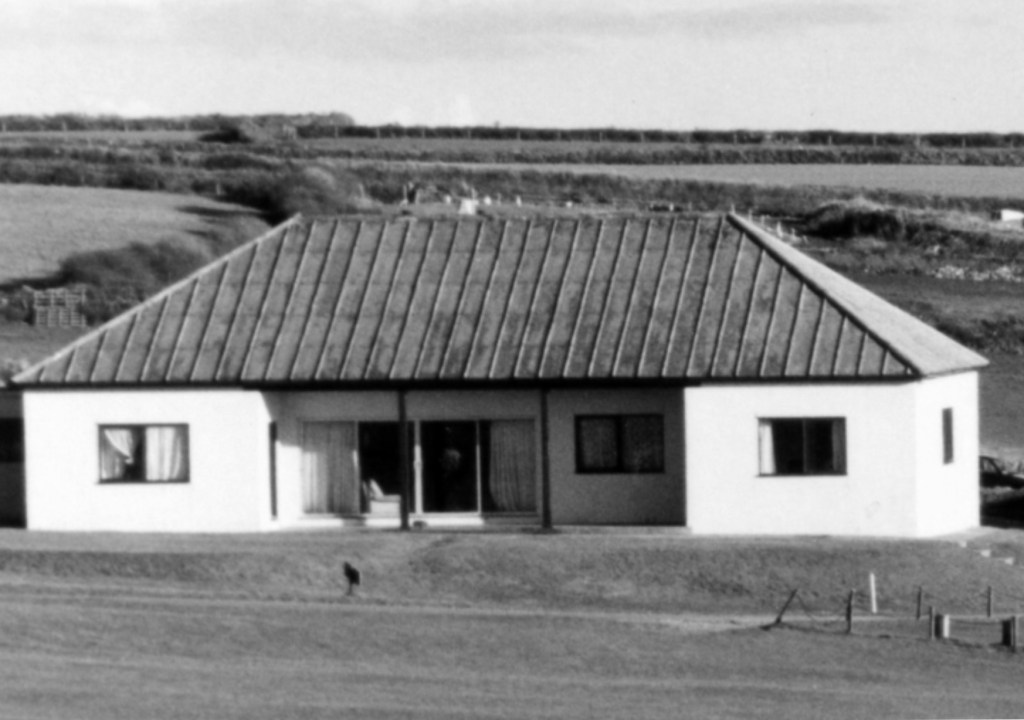
The West Briton failed to mention that the space for the honorary secretary had been overlooked and that was why he had to share the room with the bridge players.
A few years later there is a reference to the hope that water for the clubhouse could be provided from the new mains supply but the discussions were rather protracted and the possibility of diverting rainwater from the clubhouse launders was raised. In June 1931 a contract was agreed with Mr Brewer of Perranporth to haul 500-gallon containers of water to the clubhouse at 10 shillings (50p) a trip. This was inconvenient and costly and a more permanent solution had to be found. To provide the necessary finance for the installation each member was to be asked to contribute between two shillings and sixpence and five shillings (which presumably did not happen as Perranporth Estates later claimed to have provided the water supply). It is unclear how long this took to achieve but the rule of cause and effect came into play in August 1932 when it was discovered that the abundant supply of water had resulted in the cesspit being inadequate. In short, it was flooding and none too 18 pleasant for those in the vicinity. A new overflow pit was necessary which Healey & Co installed at a cost of £7.10.0.
Mr and Mrs S H Edwards took up their appointments as steward and stewardess on the 20th June 1927 at a combined salary of 25 shillings (£1.25) a week. They ran the bar, kept the premises in good order, received green and telephone fees and provided teas and luncheons as required. The club received the profits from the bar including those from the sale of tobacco and chocolate. A later entry records that the stewards also sold golf balls on the professional’s account.
Most minds were focussed on the construction work but there were those who were looking to the future, to a time when the club would be in operating mode. Systems and procedures had to be put in place and there was also the pivotal appointment of a captain. Mr Wilson had been one of the main drivers in the creation of the club and it was felt that he should be invited to become its first captain. This appears to have been a popular choice and he was asked to stand. Another step along the road to becoming established was taken in February 1927 when Perranporth Golf Club was elected to the Cornish Golf Union.
A notice appeared in the clubhouse advertising that “the professional will give instructions in golf on Saturdays from 1.15pm and is prepared to supply all golf requisites”. The rules sub- committee, too, had not shirked in its task and a draft of the first set was available for consideration. It was quickly approved and distributed to members.
Letter to Members and Bond-holders – 11th March 1927
The committee, in their circular letter of the 20th October inviting applications for bonds, expressed their decision to limit the amount to £3,000. Bonds have been taken up to the value of £1,800 by 142 bondholders. The membership is now 180. The cost of construction estimated by Mr Braid was £2,800 exclusive of clubhouse and the expenditure to date is about £1,400. In order to complete the construction on Mr Braid’s plans, and to proceed with the erection of the clubhouse, a further sum of £1,200 should be provided as soon as possible, and the committee are of the opinion that bonds should now be issued up to the limit fixed by them in October last. At the meeting of prospective bondholders held in the autumn most of those present intimated their willingness to take more bonds “if required”. The committee, therefore, now invite further applications: and, if you are willing to increase your holding, will you kindly fill in the attached application form and send it to the honorary treasurer, Mr T H Williams, Barclays Bank Ltd, Truro, together with your cheque. The honorary secretary will be glad to receive applications from those not yet holding bonds and who are desirous of joining the club.
For the men working on the course it had been a busy winter but now, with spring just around the corner, plans were being put in place for a “course christening ceremony”. It was held on the 2nd April 1927 and included a celebration lunch for members and friends. The formal opening was to be a little later, in June, and would be a much grander affair when it was hoped that the president, Lord Falmouth, and Colonel Protheroe Smith would attend. Perhaps optimistically, the Duke of Cornwall was to be invited to formally open the links and Lord Falmouth was asked if he would issue the invitation. Unfortunately Lord Falmouth declined to do so but, undeterred, the committee agreed to invite the Duke to visit the club on a later occasion. I have found no evidence that he ever did.
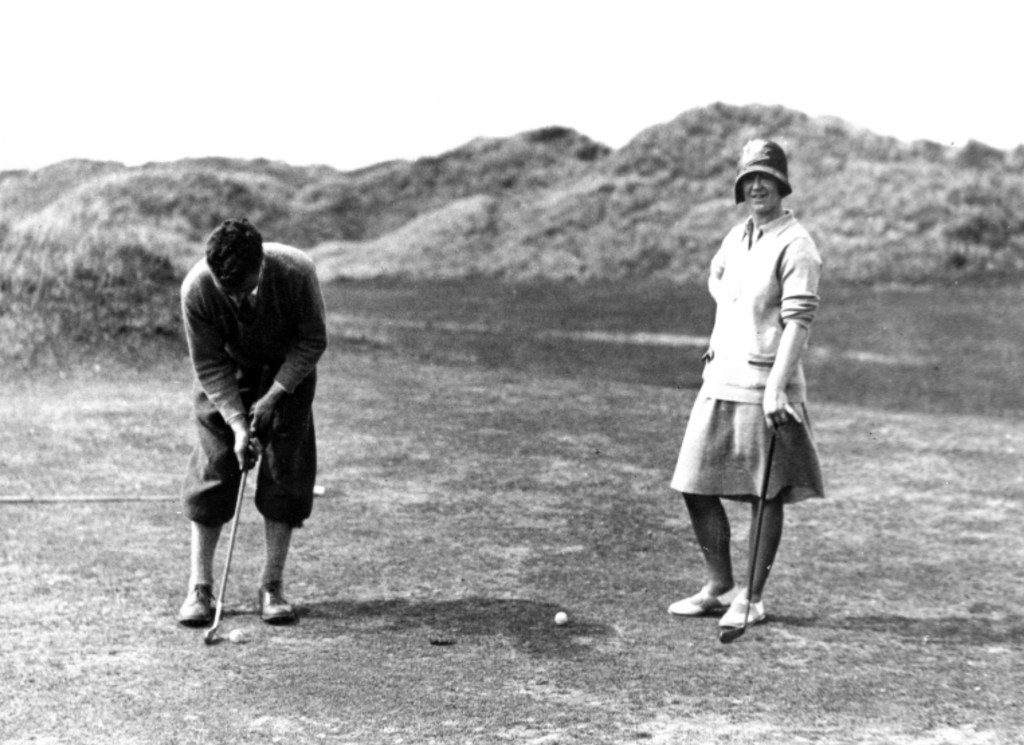
Letter to Members and Bond-holders – 11th April 1927
You will remember that in the last letter to members reporting on the progress of the links an appeal was made for additional financial support. Further money is very urgently needed and unless it is received, and received promptly, there is a likelihood of the excellent work already done on the links suffering to a very serious extent. The money is required chiefly for the following: Tractor and roller Clubhouse Furniture of clubhouse Construction of road to clubhouse Wages for minimum number of men to get links into playing order. A combined effort is now necessary to procure the sum of money to enable us to complete the course as planned by Braid and it has been decided that each member should be asked to either take up bonds or to increase his existing holding by at least one bond. 20 We have 180 members so that if members will respond liberally to this proposal success is assured. May we therefore appeal to you on behalf of the committee to support this suggestion and to take at least one or more bonds? The committee would remind members who are not bondholders that two bonds will limit permanently their annual subscription to £2.2s.
Andrew Fuller, Chairman, T H Williams, honorary treasurer, W Thomas, honorary secretary.
At the first annual general meeting, on the 19th April 1927 in the Women’s Institute Hall in Perranporth, no nominations were received for the positions of captain, vice-captain or honorary secretary. Whether or not this was a surprise I do not know but it must have been disappointing that in this young and vibrant club no one was prepared to throw their hat into the ring. Perhaps it indicates a display of modesty or maybe a lack of pre-meeting “business” in the bar. You will recall that Mr Wilson had been invited to stand as captain but, for whatever reason, he did not.
Dawes’ bungalow had been the home for the professional but it was available only until the end of April 1927, no doubt because it was a holiday let. In May, James Hearn moved to a property near Goonhavern for which each committee member had signed a guarantee ‘jointly and severally’ to be responsible for up to £50 to the bank.
The Grand Opening
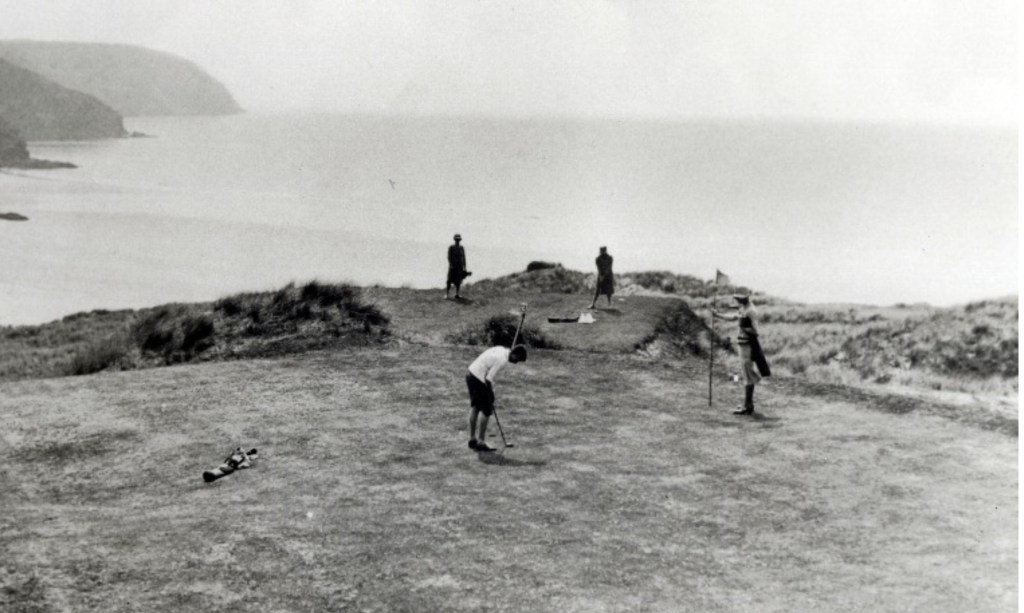
The officers and committee have pleasure in announcing the opening of the first 9 holes for play on Friday the 24th inst.
It is hoped that all bondholders and members will make a special effort to be present.
As June approached, the members must have looked forward to the event to which they had all been working – the formal opening of Perranporth Golf Club. Initially the course would be only nine holes, but nevertheless it would be officially open for play, and it was hoped that the back nine (current 1st to 9th) would be available before too long. The West Briton too anticipated the opening with an outline of the club’s brief history. Some of the language is dated but the hole-by-hole description of the course was clearly written by someone who understood the finer points of golf.
The first nine holes skirt the boundary on the eastern side and then finish down the centre of the course and the second nine holes run around the western edge and again return through the centre of the course. Of the nine holes on which play will take place, the first is 316 yards in length. The drive is past the clubhouse over slightly rising ground and a good iron shot should find the green in two. While the green is well guarded by natural hillocks there is nothing at the moment to catch an indifferent drive but it is intended to transform two or three mounds into natural sand hazards in the immediate future to catch the topped tee shot. The second hole is one of the longest on the course being 415 yards long. A carry of 160 yards faces the driver but a good shot will reap its reward for the green is then opened up. It will take a fine second shot to fetch it as the green is of a plateau type. The average golfer will be content with a five which is the bogey for the hole. Shots which are short, or over, will have a difficult pitch on to the green. The third hole presents another carry of about 150 yards from the tee with penalties awaiting a sliced or topped shot. The length of the hole is 278 yards. Following a good drive a massive niblick pitch will land the ball on the green which is also a raised one. The fourth is constructed on similar lines; it is 280 yards long, the second shot to the green requiring accurate playing. The green is placed on the extremity of the course and while there are many beautiful sea views in going around, nothing can surpass the delightful outlook from this particular shot – in fact, one of the charms of these links are the delightful views which are from time to time opened up. The fifth hole is 360 yards in length and is one of the most attractive on the course. The drive to reach its full benefit must be accurately placed between the hills. A slice lands one into a deep sand bunker and on the left is some very hilly rough land. A long driver has the hole well opened up and while the courageous would assay reaching the green with his second, the majority of golfers will be quite content to get there in three for the approach to the green, also raised, is very well guarded, there being undulating ground in front and a very deep natural bunker on the right. The sixth hole measures 345 yards and here again a good drive is necessary if trouble is to be avoided. After that it is plain sailing over open ground but a by no means easy four, which is the bogey for this hole owing to the present nature of the lies for the second shot. The seventh, which measure 190 yards, is the shortest hole on the outward journey. It is a good one-shot hole on to a natural green leaving very little margin of error, there being some rough country on the left and hillocks on the right guarding the green. The eighth is the second longest hole of the nine and requires two good wooden shots to reach the green in order to collect the bogey four. The ninth presents no great difficulties. It is 233 yards long and provided that the tee shot is straight, a chip mashie will find the green. The inward nine are not ready for playing on but it is hoped they will be early next year.
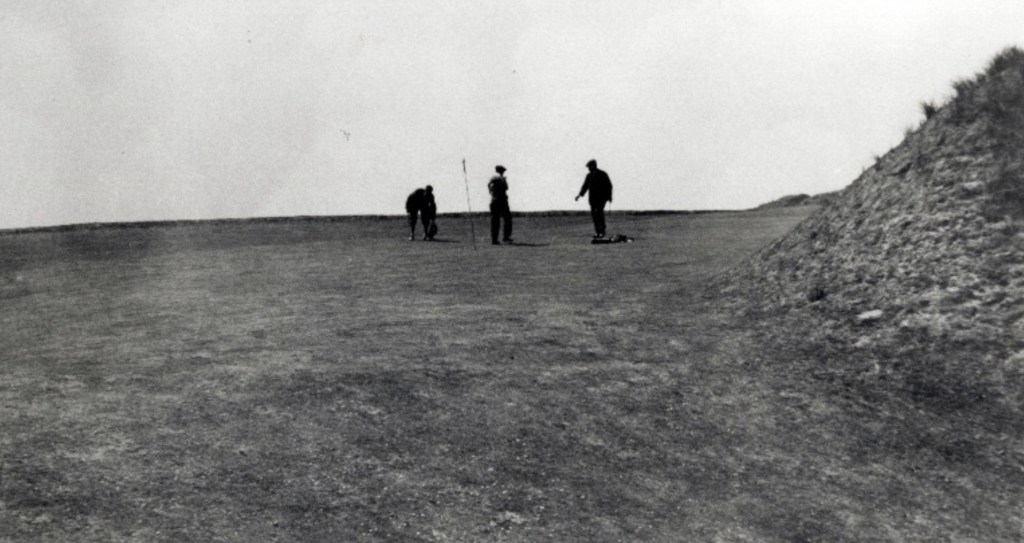
The opening was to be a grand affair. A flagpole had been erected to which James Hearn had provided a “lick of paint” and the honorary treasurer was delighted to receive a donation of £50 from the GWR which had been promised when the links were open for play.
The great day arrived with the weather fine but windy (now that is unusual!). It is claimed that the golf course is built on the highest windblown sand-dunes in Europe.
A large number of people heard Dr Fuller briefly relate the circumstances and all the hard work leading up to the day. He outlined the programme of events and thanked the many people who had worked so hard to make it happen. The club flag, presented by Mr Bird, was unfurled and Dr Fuller drove a ball from the 1st tee (current 10th) before declaring the first nine holes open for play.
What better way to celebrate the opening than with a golf competition, the first in the club’s history, for which a temporary bogey of 37 was fixed for the nine holes (current 10th to 18th). Mr J F Healey presented the “Birthday Cup” for the men and there was a committee’s prize for the ladies. (At some point in the future the ladies’ trophy was “lost” and not found until sometime around 2005 when alteration work was being undertaken at the Ponsmere Hotel. It was renamed the “Ladies Challenge Cup” and is now competed for once again.)
Programme for Friday 24th June 1927 2.00pm
Opening Ceremony by the Chairman Dr A Fuller Competitions
(Starting times will be posted in the clubhouse)
9-holes (Medal) Competition, under handicap, for Birthday Cup presented by J F Healey esq. to be played for annually
9-holes (Medal) Ladies’ Competition, under handicap, for prize presented by the committee
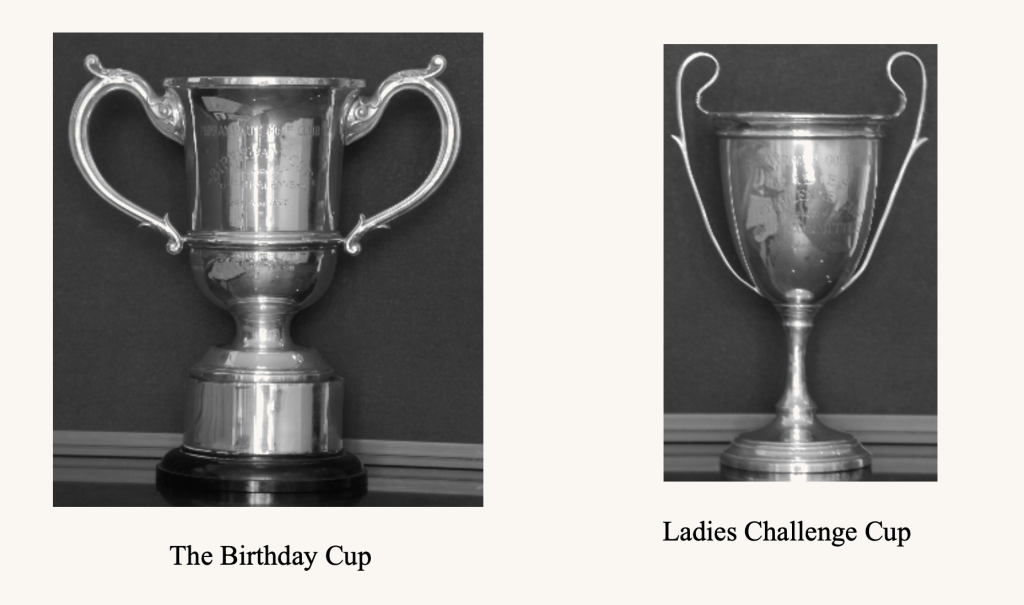
There were 24 entries for the “Birthday Cup” and 12 for the ladies’ competition, and at the end of the day the club recorded the first winners of its first official competition. Mr C N House took the cup with a net 45 and in joint second were Mr Cornelius and Mr Hugh Healey with a net 46. Mrs Casley won the ladies’ competition with a net 59. Tied in second place on net 60 were Mrs Cornelius and Mrs Hugh Healey.
Up and Running
The outstanding business from the AGM was dealt with at a meeting in June when Mr Knowles was elected the first captain of Perranporth Golf Club. Mr Healey was vice-captain, Trevor Robinson the honorary treasurer and Captain W Thomas the honorary secretary.
The lady members formed a ladies’ section and at their first meeting Mrs A J Cornelius was elected ladies’ captain, Mrs Casley vice-captain and Mrs H Healey the honorary secretary. Mrs A Fuller, Mrs R Fuller, Mrs J F Healey and Mrs E T Robinson were elected to serve as members of the committee.
It was around this time that Mr Wilson resigned from the committee. It will be remembered that he was also a member of the syndicate and that he had been invited to become the first captain. Unfortunately, nothing has been found to explain why he stepped down.
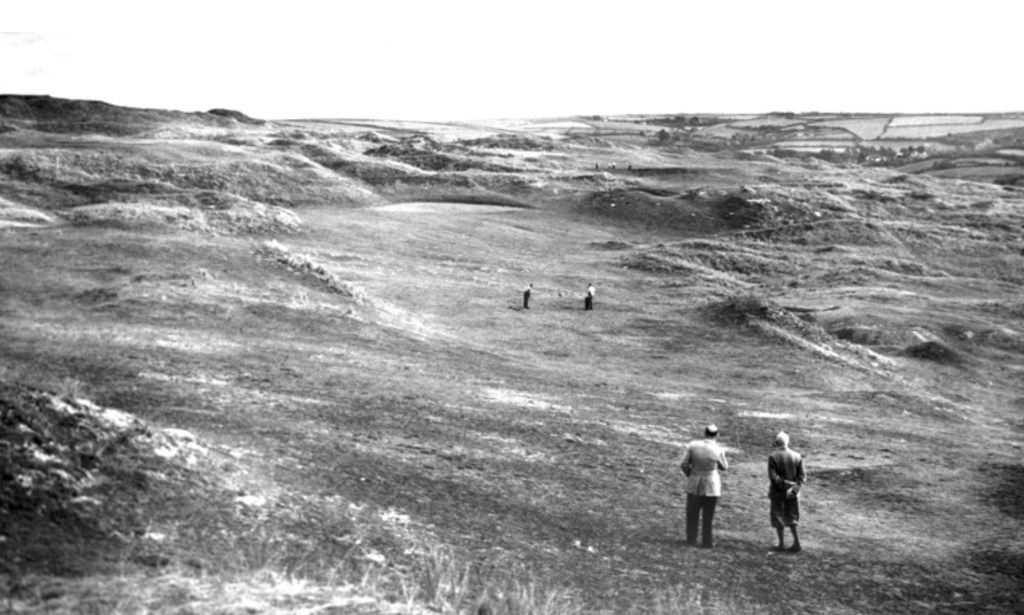
There is no longer any doubt that the Perranporth golf course will eventually be one of the finest in the West of England.
—West Briton
The West Briton wrote of the difficulties in creating the course and referred to the gloomy predictions of the struggles to keep it free of blown sand and from the serious menace of rabbits. It talked, too, of the magnificent views providing compensation for a poor card but chiefly it recognised the distinct challenge at every hole which, it said, was the reason that the course will inevitably win a large following.
Straying animals were not unusual at this time but the farmers themselves were now accused of trespassing and stealing sand from both the syndicate and the club. No doubt this was something that they had done from time immemorial.
As no one will need reminding, Perranporth can be a cruel place when the wind and the rain drive from all directions, often horizontally, but all of that can be forgiven as a shot is “creamed” down the centre of a fairway to leave a wedge shot to the green. With the weather in mind, however, three shelters were erected at locations across the course so that when the heavens opened there was somewhere to take cover.
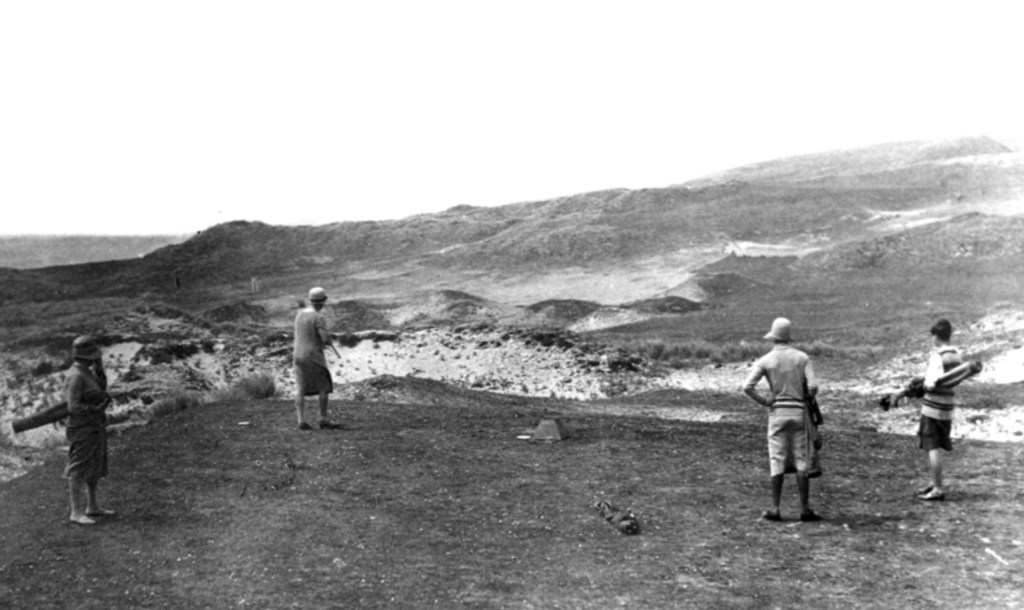
The course had been in play for about three months when the committee asked its landlord if it would be possible to acquire some additional land on the north-east boundary, adjacent to the 2nd, 3rd and 4th holes (current 11th, 12th and 13th). The response was positive but it would be the subject of an additional lease for which there would be a charge of £5 a year. The club responded that the figure for the additional area was not proportionate to the rest of the site: £1 would be a fairer figure. A few weeks later Mr Healey confirmed that he and his co-directors had agreed to grant a lease for the additional seven acres of land at a rent of £1 a year.
The club had again raised the question of purchasing the freehold and the response to that must have been a surprise as it was an offer to sell the entire course, including the additional land to the north-east and the area between the clubhouse and Budnic Hill, for £5,000.
Letter to Members and Bond-holders – December 1927
A year having elapsed since the formation of the club, the committee decided to convene a special joint meeting of members and bondholders at the clubhouse on Friday the 9th December at 4.30 pm.
Reports will be presented relating to the progress and prospects of the club: separate financial statements to date on both construction and revenue accounts will be laid before the meeting: a scheme to ensure the redemption of bonds will be explained and the opinion of the meeting taken as to its adoption. The landowners having made an offer to the club to sell the freehold of the links, the members will be consulted as to the desirability of accepting the same. The committee have completed an arrangement for an extension of the northern boundary so that Braid’s original layout cannot be affected by any future building operations. This land, about 7 acres, has been acquired at a nominal rent, on a lease to run concurrently with the original lease. Bonds to the value of £2,200 have been issued and the whole of the amount has been expended on the construction of the links. It will be greatly to the advantage of the club to complete the second nine holes by the coming spring and means for raising the required amount to carry out this work will be considered. As the matters to be dealt with at this meeting are of considerable importance, your attendance is particularly requested.
Having digested the landlord’s about-turn the club responded that the suggested figure was out of the question, £3,000 to £3,500 was more appropriate and even then, there should be a 10-year option. The syndicate’s reaction is not recorded but we soon find Mr Carlyon of Truro assembling a package of measures to raise the necessary funds. His plan was to turn the club into a limited company and to arrange a mortgage, the security for which would be the whole of the assets excluding the clubhouse, which was already mortgaged. Debentures would be issued to cover the cost of converting the existing bond issue and providing capital to complete the second nine holes. There would be an issue of preference and ordinary shares and subscriptions would be raised to £3.3.0 for members who were not debenture holders.
Letter to Members and Bond-holders – 20th December 1927
At a special meeting of members and bondholders held on the 9th inst. reports were presented showing a membership of 183, of whom 155 had paid their subscriptions for the current year. The construction account showed a debit balance of £214 and the revenue account a credit balance of £83. Since the opening of the club at midsummer last the receipts from subscriptions, green fees, etc., amounted to the satisfactory total of £607.
A resolution was passed requesting the committee to consider the conditions under which the freehold of the links could be purchased and to report at a special general meeting.
It is therefore the committee’s intention to secure a definite offer from the Perranporth Estates Co., Ltd., and consider a suggested scheme for the formation of a limited company for the purpose of issuing debentures to cover the existing bonds and extra capital which would be required to purchase.
It was the unanimous opinion of the meeting that the second nine holes should be completed as soon as possible and it was pointed out that a further sum of £600 would be required for that purpose, and which would increase the total issue of bonds to £2,800 (Mr Braid’s estimate). To enable this work to proceed at once, the sum of £340 was subscribed by the members and bondholders present. I am requested to ask you whether, at this juncture, you will assist in providing the balance of £260: and anticipating that the support of those members and bondholders who were not present will be as generous as those who attended the meeting, additional labour is being engaged with the view of opening the second nine holes early in the coming summer.
At this point the plan to convert the club into a limited company and to purchase the course seems to disappear off the agenda and we are left to wonder whether the syndicate simply refused to lower their price. In hindsight it is easy to consider this as a chance missed but it should be appreciated that the original asking price of £5,000 would equate to about £250,000 at today’s value. The members were understandably impatient to play on an 18-hole course but completion of the back nine (current 1st to 9th) was being held up through a lack of funds.
Once again an appeal was made and it seems likely that it was successful because work was soon under way again with ten men under James Hearn. It seems that every member had a view on how the work should be tackled because James Hearn had to be reminded that he should only act on the instructions of the captain or the honorary secretary. He was not to take instructions from any individual member of the committee.
One particular aspect of the back nine was causing concern, the approach to the 12th (current 2nd). It was agreed that two sand banks should be removed but finance was the ruling factor and the work was deferred until funds were more plentiful. We are left to wonder where they were and whether this work was ever carried out.
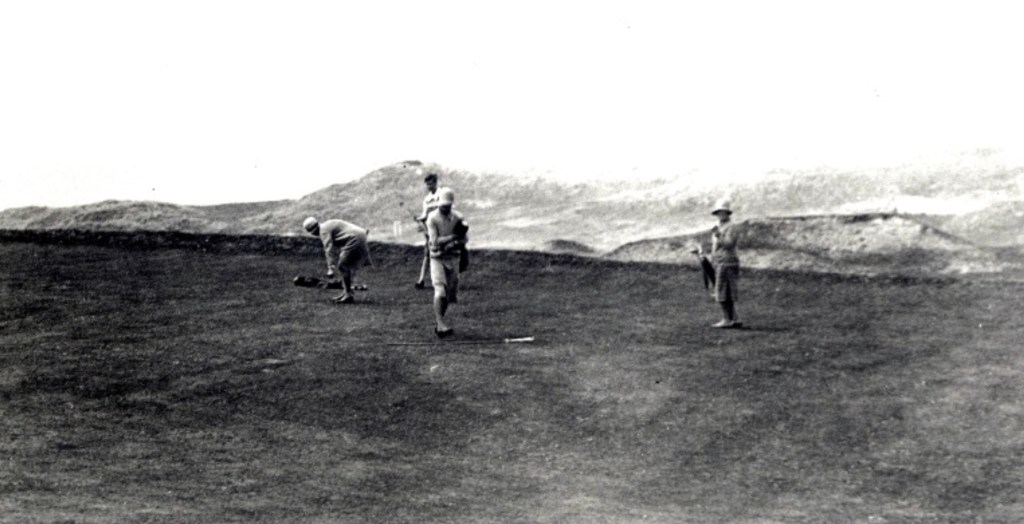
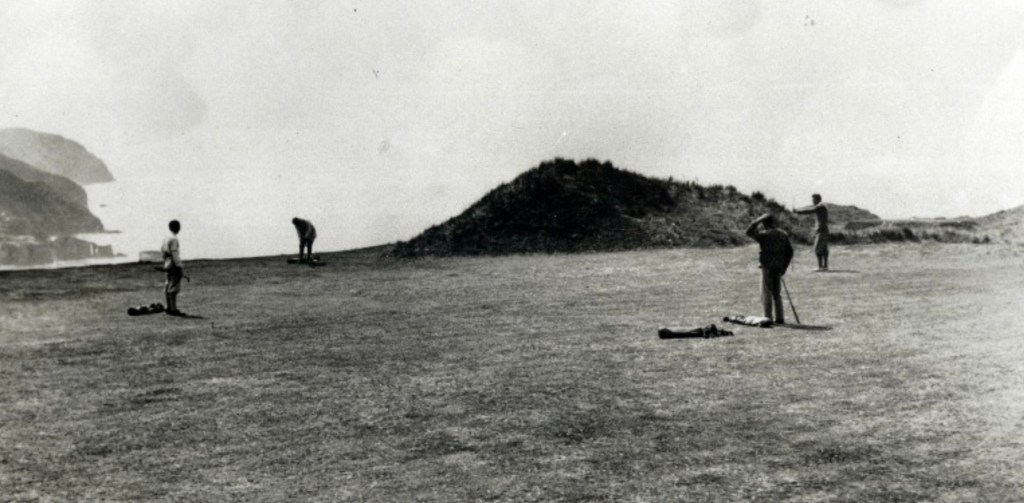
[All of the foregoing 1920s/1930s photographs were taken by photographer A W Jordan ]
For some years the coastguards had used a part of the course for practice, for which they paid the club the princely sum of one shilling (5p) a year. Now, with the course becoming busier, they were in the way and they were “given notice to vacate the ground occupied by them for rocket practice”. A while later they were still being pressed to remove their rocket practice post.
According to Bill Mitchell there was also some coastguard activity during the late 1940s when they practised their Breeches Buoy technique between the 17th tee and the 2nd fairway.
Although work was progressing on the back nine it was not at a rate to satisfy everyone and the committee were looking for someone to shoulder the blame. James Hearn was the target of recriminations. Some felt that a proper greenkeeper should be appointed and that he should concentrate on helping members to improve their game. It seems, however, that nothing changed and James Hearn continued in his dual role.
To be fair, there were other difficulties including finding good-quality turf to complete the 11th and 12th greens (current 2nd and 3rd). One possibility fell by the wayside when it was found that the turf had also been promised for the new links at Penhale. It was hoped, however, that some more would be available from the dynamite works at Cligga. This clearly materialised as Viv Hill recalled a local man called Annear saying that he had delivered it from there by horse and cart.
Perhaps it was the pressure of finishing the back nine but this seems to have been a particularly stressful time with a continual flow of instructions and counter- instructions. Mining rights under the links were a major concern and in February 1928 Sir Walter Peacock was asked whether there was any chance that the Duchy of Cornwall would assign the rights in return for a reasonable rent. After all, neither the landlord nor the members wanted the new course carved up by renewed mining activity.
There was also the ongoing damage caused by our furry friends – the rabbits. They were frustrating every attempt to achieve a good growth of grass and were breeding like…well, like rabbits. The trapper was doing his best to control them but even when he was successful he was criticised. The sight of the poor little creatures lying dead in the traps was causing offence to the sensibilities of some members and an instruction was issued that the bodies were to be removed from the traps before 9.00am.
It was not all bad news, however, and even though it was still only a nine-hole course Perranporth Golf Club had established itself and now took the important step of joining the Cornwall County Golfers’ Alliance at an annual cost of £2. After all, construction of the back nine was well advanced and in anticipation of its completion score cards were being produced for the full-length course.
The end of construction work was now in sight and men were gradually being laid off until just five remained working under the professional. Mr E Lavin led the team comprising W Harding, T Kempthorne, J Farning (sic) and C Hearn.
A little later, with construction work complete, the committee made a gesture which seems at variance with the recent criticism levelled at James Hearn: they made him a presentation for his efforts in building the course. The steward, too, benefited from the improved mood as he was offered “certain hours off” and a holiday – in due course!
It was now appropriate to relieve James Hearn of some of his groundwork duties so that he could spend more time providing golf lessons, and because of the increased opportunity to earn from his teaching activities his salary was reduced to £1 a week. Perhaps unsurprisingly he was not entirely happy with this apparent fait accompli. His guaranteed income had been reduced by 50% and a period of inclement weather would see him seriously out of pocket. It was a reasonable point and his complaint fell on sympathetic ears; he was given the guarantee of a combined minimal income of £2 from salary and fees.
Completion of the construction work meant that the lorry was no longer required and, as someone pointed out, it had broken down so often that it might as well not have been there. Decision made, it had to go and be replaced by a horse which would pull the cart and other equipment. Unfortunately, before the sale could be arranged, it was “laid up” again and with no available money a horse had to be borrowed from Bryant Mitchell. A little later he organised the purchase of a reliable horse, light cart and harness for £15.10.0. Maintaining such an exposed, sand-strewn course in good condition was a challenge. Added to that was the neglect shown by some members who seemed averse to replacing divots (can you imagine that?). Tempers must have been a bit frayed as one member referred to the behaviour as “scandalous”.
Off-course activities were proving popular but so far these had been restricted to casual get-togethers. The clubhouse was not large, but organised events now began to appear on the calendar with dances, card games and other activities. There was more to this club than just golf. In 1928 Mr Knowles was nominated for a second year as captain but just before the annual general meeting he announced that he would be unable to continue. This must have come as a bit of a shock and the committee was ill-prepared and unable to find anyone willing to take over.
Once again, the AGM had to proceed with no nomination for the top job. Mr Knowles, the outgoing captain, reported that the second half of the course would be open during May of that year. It was still hoped to purchase the freehold of the course but matters had not progressed, mainly because of the need to clarify the mining rights. He considered that the links would be good within three years and that after five years they would be about the best in Cornwall.
Membership had grown to 193, including 74 from Perranporth and 71 from Truro. The Right Honourable Viscount, Lord Falmouth, was re-elected president and Fred Healey became vice-captain; the appointment of captain was left for a subsequent meeting. Various donations had been received and £38.10.2 was banked from the sale of trapped rabbits, the equivalent of nearly 20 subscriptions.
The members met again on the 18th May 1928 to complete the business left over from the AGM. Fred Healey, elected as vice-captain at the AGM, moved up to become the new captain and John Paull took over the position of vice-captain.
From the rule book of that time we can see that visitors were charged two shillings and sixpence (12.5p) for a round of golf on the 18-hole course so, although no date is given for the completion of the back nine (current 1st to 9th), it must have been as suggested at the AGM.
As an aside, there is an interesting reference to the Newquay Town (Artisans) Club. Challenges began to arrive from other clubs and in June 1928 there were inter-club matches with St Austell and West Cornwall. The ladies, too, were finding their feet and joined the Ladies’ Golf Union. The desire to be in charge of their own future must have been a powerful driver and the possibility of buying the course surfaced yet again. A lack of funds was the only barrier and considerable committee time was spent discussing how sufficient money could be raised for the course and, strangely, for “the erection of a hotel”. The task passed to the finance committee and must have appeared on many agendas before ownership of the course finally became a reality many years later.
The literary side too was to be catered for, and a daily copy of the Western Morning News was purchased and placed in the bar for members to read.
In July 1928 the rabbit trapper resigned. Not only was he responsible for controlling a nuisance, he also brought in much needed funds, the rabbit being the staple diet of many families. It was also discovered that about 50 traps had been stolen. They could be replaced but a good rabbit trapper, it seems, was not easy to find.
There were also problems with James Hearn and his brother, one of the greenkeepers. Both apparently tended to disregard instructions they disliked. One had to go, and it was Hearn the greenkeeper who was given his cards. He was to be replaced by a greenkeeper with experience of rabbit trapping, a combination of skills which subsequently proved difficult to find. If Hearn the professional thought that he had come out of it unscathed then he was mistaken. He received a list of grievances and a warning about his future conduct. With the threat of dismissal hanging over him he returned to work, promising to follow instructions. Strangely, it had only been a few months since the recognition of his good work in building the course.
The entrepreneurial skill of the greenkeepers now became apparent by the discovery of a sideline business, selling second-hand golf balls. The committee took a dim view of this and issued an instruction that all golf balls found by employees must be returned to the professional. As a sweetener, there was to be a reward of 3d (1.25p) a ball.
In September 1928 Perranporth Estates reduced the asking price for the course to £3,750, a much more manageable figure and quite close to that suggested by the club. The Duchy of Cornwall, too, had responded by stating that they were considering “terms for the protection from damage by mining”. A few weeks later, however, hopes were dashed on this when they advised that they would not sell the mining rights but would “fix those sites at which shafts might – in certain events happening – be sunk”. They also asked for a payment of £1,500 for the required protection against damage caused by mining. The landlord thought this not unreasonable and suggested that it should be paid in two equal amounts and shared by the club and itself.
Cornish Golfer: Many years ago, our author Tony Mansell was playing a shot from behind the 8th green when the ground quietly gave way beneath him. He dropped some two feet, still holding his address over the ball. His playing partner, more bemused than alarmed, called across in broad Cornish tones to check that he was all right.
In February 2026, a much larger reminder of the area’s mining inheritance appeared off the 2nd fairway.
Both matters were referred to the finance committee meeting in October, and after he had read the two letters Mr Healey withdrew from the room to avoid any suggestion of a conflict of interest. He was of course also a member of the syndicate. Mr Carlyon of Truro was appointed the club’s legal adviser for all matters relating to the acquisition of the freehold and they immediately began again to consider the options. Unfortunately Barclays Bank decided that they could not advance a loan on the security of the links. This was disappointing but there were other options, and Mr Carlyon, once again, began to consider the possibility of forming a limited liability company. It was felt that this would enable the club to raise the necessary funds for the purchase of the freehold and for its share of the monies required by the Duchy of Cornwall.
The land in question would be that contained in the original lease plus the additional strip to the north- east, and the total amount required was £4,500: £3,750 for the freehold and £750 for the Duchy. It was proposed to raise £2,500 by mortgage and £2,000 by share issue. This would take time, however, and Perranporth Estates was advised of the situation and asked whether it would extend its timescale. It is not apparent why matters did not progress but there is little doubt that the reason was related to the difficulty of raising the funds, and after eighteen months the members were informed that no progress had been made. There were fears that the delay could result in an increase in price or maybe that it would be affected by the installation of a water scheme. The landlord’s response was that a valuation would be made at the time of sale. With this latest disappointment there must have been many who feared that the chance to obtain the freehold had now been lost.
By the AGM in April 1929 membership had climbed to 227, including 200 playing members, 17 non-playing and 10 juvenile or honorary members. Proceeds from the sale of rabbits was £78.17.2, which must have represented a tidy number of pies. Of course, this was still about 25 years before the outbreak of myxomatosis in this country and at a time when rabbit appeared regularly on many tables.
Finance was a constant problem for the infant club and now it was the construction account that was giving the honorary treasurer a headache. The deficit of £482 had to be cleared or he would be forced to transfer funds from the revenue account with the result that staff numbers would have to be reduced. An appeal was made to all members but unfortunately it was not successful. Perhaps the urgency of the request was doubted, considering that the club was actively planning to go further into debt by buying the course freehold.
The wide, open space of a golf course is difficult to police and over the years there have been many instances of damage by those who feel they have a right to spoil the property or enjoyment of those who like to swing the club. In 1930 it was the theft of sand, which was disappearing from beneath the bank on the 3rd fairway (current 12th). Perhaps alerted to the fact that the game was up, those responsible ceased their nefarious practice and crept away without being identified.
Cornish Golfer: On 12th April 1930 the Western Morning News reported:
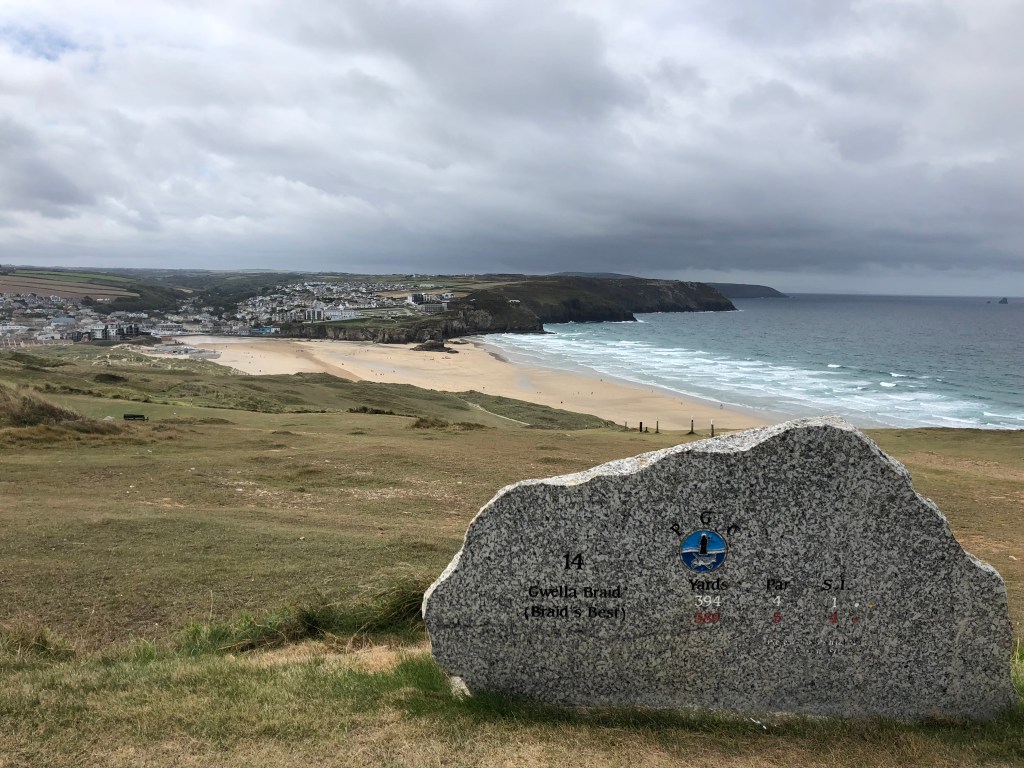
“Commanding a magnificent view of both sea and landscape, the golf links at Perranporth have many outstanding features. In existence for only about three years, extraordinary progress has been made, and the links to-day offer a good test of golf. Constructed on the sandhills overlooking Perranporth beach, with the township nestling alongside the many difficulties which construction presented are being gradually overcome.- The course is one of 5,750 yards, and the bogey has been fixed at 75. The course was laid out by Mr. J Braid and has been so constructed that the first and ninth tees are quite adjacent to the clubhouse…The course now measures 6296 yards, par 72, and there are seven blind holes. The 394 yards 14th hole is named Gwella Braid (Braid’s Best).
The dichotomy of an ambitious club wanting to move forward but at the same time being starved of funds now began to become apparent. Despite all requests the construction account was still overdrawn, and it must have been with considerable disappointment that the threatened staff reduction took place.
The horse too came under threat. It was under-used during the winter months and costly to feed. Mr Hawkey agreed to buy it and to provide another before the next growing season. The idea seemed sound but when spring arrived a replacement could not be found. The grass was growing and there was nothing to pull the mower.
During the 1930s the road surface on Budnic Hill was far inferior to what it is today, and to make matters worse the junction with the golf club was particularly poor. Vehicles had been damaged and the committee was fed up with the complaints. Something had to be done. The problem was considered, it needed decisive action; the greenkeepers were instructed to “remove the large stones”.
A few years later, in 1935, the entrance was still a problem but now it was the line rather than the surface. Mr Healey provided the necessary manpower and the junction was reshaped to permit easier access.
The committee’s relationship with James Hearn had been variable, and on the 5th September 1930 it came to a head: he was dismissed.
His replacement was to undertake two roles – to work under the greenkeeper in the mornings and undertake professional duties in the afternoons. The wheel had turned full circle. Even before the post was advertised there was a report that the assistant professional at Tehidy was seeking a change and could be interested. He was interviewed, offered the job and in September Len Connett joined the staff on the terms outlined above and at a salary of £2 a week. Just before Len arrived there was a fire in the professional’s hut when the wooden building and all of the stock was destroyed. He had to begin his new job by sharing an office with the honorary secretary. Fortunately, the building and contents were insured and a replacement 10 ft 6 inches x 8 ft shed was ordered and erected next to the drive.
This was the golden age of the caddie when most players, if not all, wanted to delegate the tiresome task of carrying their clubs and were quite prepared to pay for the privilege. After all, that was what the professionals did! The initial attempt to employ two school leavers as combined caddies and trainee greenkeepers was unsuccessful. It was hoped that a visit to the local headmasters might produce some likely candidates and even while the hunt was on, demand increased and the requirement was for four. It is not clear how successful this initiative was, but a few years later the club was still trying to find some through the Labour Exchange. It seems that caddies were as rare as hens’ teeth. In 1931 a proposal that six such employees should be engaged at 10 shillings (50p) a week received the necessary support and it would appear that a cadre was soon in place. The fee was one shilling and sixpence (7.5p) a round or one shilling (5p) for nine holes. Half was to go to the caddies and half to the club, but the boys were entitled to keep any tips for cleaning clubs. They were not allowed in the professional’s hut but a “rough shed” was provided for them. The steward was to be the caddie master; he was responsible for their conduct and for teaching them their duties. In 1933 access to caddies was still a problem and the members were demanding that an effective system be put in place.
Meanwhile, there was a problem brewing of potentially greater consequence. The ship, launched on a tide of enthusiasm, seemed to be faltering. Despite strenuous efforts to economise, the current account was overdrawn and the situation was worsening. As required by the terms of the lease the club was now paying the landlord an increased rent plus 10% of all green fees. It had of course been entirely foreseeable, but income had not increased sufficiently to fund the deficit. The total receipts for 1929/30 were £950 whereas the expenditure was exactly £1,000. Income had to be increased or it would become impossible to carry on. This was the harsh reality of the situation and when the committee met to consider its options, the first suggestion was to raise subscriptions for ordinary members from two guineas (£2.10) to three guineas (£3.15).
The second idea was more contentious: it was to increase the subscriptions for the 130 member bond-holders by one guinea (£1.05). These were the people who had kick-started the entire project and in return had been assured that their subscription would be pegged for ever. Notwithstanding that, they were to be asked if they would consider waiving the condition. For some reason this was not a blanket decision, it was to apply only to the men. The honorary treasurer warned that unless these measures proved successful in increasing income then the future of the club was at risk. It would either close or would have to be re-formed as a limited liability company.
Whilst the committee wanted to make it clear that they were in a tight spot, there was a reluctance to fully acquaint the members with the stark reality of the situation. Equally, there was a concern at reneging on the promise given to the bondholders and it was decided that in their case it would take the form of a request. It was hoped that it would be well received. Other members too were asked for donations or contributions to enable the club to be placed on a more secure footing. In reality, donations are only a short-term fix and the committee must have been aware that they were simply buying time. However, if they could keep the club running for a further year then maybe a more permanent formula could be found. The initial response from the bond-holders was not good. Of the 130 contacted only 40 replied. Of those, 25 were in favour, ten were against and five had declined to vote. Ninety had not replied at all and this was thought to indicate that they were against the idea. Perhaps the committee’s failure to make clear the seriousness of the situation had been a mistake.
Whatever the reason, it was time for plain speaking, and a meeting of bond-holders and officers was called to explain the full extent of the problem. Wherever possible, payments of outstanding bills were delayed, and when the Cornwall Golf Union pressed for the annual subscription the honorary treasurer refused to pay. The reason given was that an undertaking by the CGU had not been acted on and, because of this, Perranporth Golf Club were considering not renewing. Although the lack of funds may well have been the prime reason for non-payment the complaint was not without foundation. It related to the lack of action in agreeing a scratch score for the course. It took a further couple of months to sort out the situation, following which the bill was paid and the club was back in the fold.
Out on the course, the membership was enjoying its golf. There were matches against various clubs including Penzance, St Austell, Carlyon Bay, Tehidy, Newquay Artisans and Falmouth. Practical problems are usually easier to resolve than those relating to people, and it must have been frustrating to find an old chestnut reappearing on the agenda. Despite all 35 previous efforts the access road was still causing problems because, it seems, the steam roller could not turn onto the site from Budnic Hill. It sounds more like an excuse than a reason but the problem was soon overcome as the next we read is that the drive had been coated with granite chippings and a bitumen binder.
Another issue then raised its head, and a notice had to be erected asking drivers not to park in the centre of the road as they were causing an obstruction. As part of the ongoing belt-tightening process the tractor had to go; it was sold for £65 but unfortunately the buyer had understood that the roller was included in the deal, and that had to go as well. The financial problems provided the April 1931 AGM with plenty to talk about and the £37.18.6 excess of expenditure over income (known to most of us as a loss but not to accountants who like to dress it up) was a cause for concern. Lord Falmouth took the chair and expressed the hope that the economies would not be taken too far. He was confident that the problem would be overcome and that the club would be one of the best, not only in Cornwall but in the country.
Perhaps his optimism was well-placed, as when the final result of the bond-holder appeal was announced it turned out to be good. Nonetheless, the ever-cautious honorary treasurer declared that he would not be happy until the annual income has risen above £1,000. Lord Falmouth was re-elected president, Dr Fuller and Trevor Holman vice-presidents and Mr F M Jesty the honorary secretary.
In December 1931 a slow-combustion stove was installed in the clubhouse. It must have been quite a comfort to the players as they returned from their winter rounds. Clothes could be dried and no doubt the members vied for the popular positions next to the source of heat. Unfortunately, the installers had neglected to provide some protection from the hot flue and the clothes placed there to dry became hotter and hotter until they burst into flames. The fire was extinguished but urgent action was needed to prevent its happening again, when the result could be much more serious. A metal guard was immediately ordered and members warned of the danger. The situation seems to have had a “dreckly” level of urgency because a short while later the same thing almost happened again. Someone was now despatched hot foot to the blacksmiths.
Anyone who has played at Perranporth will appreciate how exposed it is – watching your ball bend in the wind or oscillate on the putting surface does not instil confidence. Spare a thought, then, for the ground staff who had to endure the conditions as part of their day’s work. There was clearly some sympathy for them as immediate steps were taken to protect them the harsh winter wind and rain. Wattle hurdles were erected “…for the benefit of the men working on the course”.
Rabbits were still causing havoc and whilst the rabbit-catcher had been reasonably successful it had been some time since any payment had been received from him. To some extent the club relied on this source of income and the honorary treasurer was concerned that it would not be forthcoming. Perhaps the new stove was not the only cause of a rise in temperature in the clubhouse.
In February 1931 a comment in the suggestion box hit a raw spot when a member, a Mr Richards, suggested that the playing draw should be made in public rather than in a closed room. Gasps of incredulity must have reverberated around the building and one member of the committee reacted angrily, claiming that it was a reflection on his integrity. He demanded that the suggestion be withdrawn or substantiated. Mr Richards assured the committee that he had not intended to accuse anyone of being less than honest. However, he was not prepared to withdraw it. For a while the issue threatened the harmony of the club. We are not told how the two sides were reconciled but the official line is that the committee decided to “continue as they had done in the past”.
An apparent improvement in the financial situation must have put the honorary treasurer in a better frame of mind and at the 1932 AGM he was able to report a £27.19.10 excess of income over expenditure (profit!), the first positive balance in the club’s history. Perhaps encouraged by the improved financial outlook, the members were pressing for the installation of electric lighting in the clubhouse. Unfortunately a quotation from the Electric Power Co for £100 caused a few hiccups and it was decided to make do and mend. An electric installation would have to wait, and almost two years later the club was still investing in oil-fuelled Tilley lamps.
The lot of an honorary treasurer is tough and now, as he saw the financial pendulum swing back again, late payment of subscriptions put him under pressure. Once more he found it necessary to prioritise payments, a constant problem throughout the winter, and by February the landlord was pressing for the outstanding rent.
Economies were to the fore, with the ladies even making flags for the green markers. In March 1933 the landlord was asked to “consider the financial position of the club” and to waive the demand for a share of the green fees. Unfortunately this was refused, but the club was given extra time to pay.
One issue which seems to have disappeared from the agenda over the few years up to that time was the lease for the additional piece of land near the 3rd and 4th holes (current 12th and 13th). It is likely that it was put to one side pending the possible purchase of the entire course. The area in question, however, had been incorporated and was in use. Unfortunately for the club, the landlord had not forgotten the arrangement and the honorary treasurer suddenly received a request for six years’ rent at £1 a year. Immediate payment was refused because the revised boundary had not been agreed, and while that might have been a legitimate reason to withhold payment the decision was no doubt influenced by the desire to hold on to the money for as long as possible.
At the AGM on the 29th April 1933 the honorary treasurer returned to a familiar theme. The euphoria of producing positive figures the previous year had proved transitory and he reported a loss of almost £57. Members were canvassed about contributing five shillings each to wipe out the deficit. In contrast to the fiscal pessimism there was a glowing accolade from international golfer Mr E R Tipple who had recently played the course and was clearly delighted.
“I can assure you that you possess a course which should please everyone that plays on it and sicken none. It is a great test of golf amidst surroundings which are unbeatable. I have no doubt that in future Perranporth will become more than a name to British golfers.”
The new honorary secretary was Mr G W Hancock and there was a pleasant event at the end of the meeting: a presentation to Len Connett who had just married.
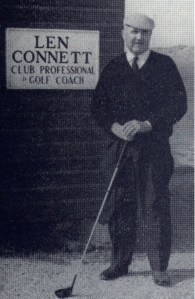
In August 1933 the honorary treasurer reported that the financial position was no worse than the previous year, in fact it showed a slight improvement. Even so, there was a cloud on the horizon in the form of cash flow, and from October to December the landlord was again pressing for payment of the rent. Even the share of the green fees was now being called for and it was possible that the landlord was anticipating that the non-payment could turn into a bad debt. The committee was anxious to maintain the goodwill that existed between the club and its landlord, and the honorary treasurer was instructed to make the payment despite the fact that they would be overdrawn at the bank.
Around this time there were many signs of a business in trouble. The finance committee refused to sanction the purchase of fertiliser, and temporary greens were in use because of a lack of maintenance. Perhaps influenced by the fear of closure, two of the mortgage guarantors decided that it was time to step down. The bank was asked to consider reducing the number of named guarantors but responded by saying that it would only agree if the mortgaged amount was reduced proportionately. There was no chance of that, and so began the difficult job of finding replacements. Surprisingly, two people came forward and the status quo was maintained. There was little financial cheer at the AGM in April 1934 when the honorary treasurer reported a further loss of almost £70. The members bemoaned the fact that whereas the club was growing in stature there was a continual failure to turn it into a profitable venture.
Despite all the attempts it seemed impossible to either improve income or reduce expenditure. It was suggested that one small economy might be made by using a donkey and cart as a cheaper means of working the course. We know that this was implemented because about three years later a new donkey-cart and harness were purchased at a cost of £3.10.0. John Mitchell recalled the gang-mower and carts being pulled by the donkey, perhaps up until the late 1940s. He said that its shed was just below the 11th green and that it was fitted with leather boots to avoid leaving hoofmarks. Voluntary contributions were always appreciated but to achieve the required level of economic stability it was necessary to increase the income or reduce the expenditure over the long term, and as the largest single item of expenditure was the rent, another letter was sent to the landlord stressing the “adverse financial figures”. It asked whether the rent could be reduced and the landlord’s share of the green fees waived.
The response was rather tetchy. The directors refused both aspects of the request and even put forward some suggestions as to how the club could put its financial house in order. This certainly raised a few hackles amongst the committee but the directors were clearly irritated and went on to list the help that they had given the club. They cited the low rent, the gift of a piece of land for the clubhouse, the use of an additional area of land to the north-east for which no rent had yet been paid, the installation of a water supply to the clubhouse and the deferment of payment of green fees. The letter was not well received, perhaps because the committee members had been made to feel like ungrateful children, always asking for more.
The situation was in danger of getting out of hand but calmer voices persuaded the more vociferous amongst them that nothing would be gained by throwing such letters at each other. It has to be appreciated that some individuals were members of both the company and the club, and so, in spite of the recent spat, there was still a deal of goodwill. It was felt that the best way forward was for representatives of both organisations to sit around the table to see whether there was any way the matter could be resolved. Representatives met in November 1934 when it was made clear from the start that no reduction was on the table. The landlord, however, did agree to defer payment of the green fees. In addition, a £10.10.0 donation would be made if 50 club members could be persuaded to contribute £2.2.0 each towards clearing the deficit. Despite the fears that must have existed in some quarters it had been an open and honest exchange and some good had come of it. A subsequent appeal to the members raised £68, to which the company added £5. However, the outcome of the joint meeting did not satisfy everyone, and there was a call from some members to reject the offer of deferred green fees and to press for them to be waived.
Thankfully, wiser heads prevailed and convinced the more bullish members not to pursue that line. After all, the landlord was asking for no more than was laid down in the terms of the lease. Perhaps the amicable nature of the meeting and the successful appeal provided some optimism but there was another bombshell just around the corner.
Both the club and Perranporth Estates had received a letter from the Duchy of Cornwall outlining the possibility of renewed mining activity on the course. The possibility that the course could be carved up was a worry, and this further increased with the rumour that discussions were taking place between the Duchy of Cornwall and a mining company.
The committee were forever trying to make the club as attractive as possible and it was probably the popularity of the ‘wizard of the green baize’, Joe Davis, which encouraged them to install an auto billiard table for a trial period. The loss of floor space was handsomely compensated for by 40% of the income going into the club’s accounts. This must have been reflected in the financial accounts for 1933/34, which showed a marked improvement with a profit of almost £35, but in these early years money was always tight and balancing the books, or even almost balancing the books, was a continual battle. Like the rabbits, the financial problems never seemed to go away.
On the plus side, membership continued to climb and the course was becoming increasingly popular. The suggestion of holding a golf week met with wide approval and when the first one took place, at Whitsun 1934, it included a variety of events for men and ladies. It must have been a welcome relief from the gloom of the Great Depression sweeping the world. Water, Water, Everywhere – But Here!
At the outset James Braid had talked of a water supply and, it will be recalled, his advice was that watering should either be “abundantly done or left alone”. The club chose the former option and a number of possible sources were investigated. In June 1928, £5 was spent on exploratory work during the dry period of July. It was to determine whether a satisfactory supply could be pumped from the high ground at the back of the 15th green (current 6th). There was no subsequent mention of this in the minutes and it is fair to assume that nothing came of it. The landlord offered a free supply from the area north-east of the course but the cost of a pumping system ruled this out. Budnick Mine adit was thought to be a possibility but, once again, cost was a problem as it would require a water wheel and a reservoir. Finally, someone came up with the suggestion of a pumped supply from the stream at the bottom of the hill but this was not attractive due to the lengthy pipework required to reach the top of the course.
Whatever the source, a holding reservoir was required and, following a decision at the AGM in 1930, it was constructed on the highest point on the course, the mound just north of the 3rd green (current 12th), close to the north-east boundary. It seems likely that it was made of metal, since when it needed strengthening the work was carried out by Brewers of Truro, an engineering company. This did not, of course, resolve the question of a source of supply. The search was still on, and following a recommendation from a diviner, a well was sunk near the 14th green (current 5th) where it seemed likely that a good supply would be found. The water was to be pumped to the reservoir by a Lister petrol engine and then distributed to every green through a network of underground pipes. HTP Ltd of Truro quoted £374 for all of the work except the sinking of the well, which they thought would cost about £20. It was difficult to see how the club could afford such an amount but it was something that had to be done. Fortunately one of the members, Mr Keall, came to the rescue and generously offered to either lend it or to stand guarantor for a bank loan. It was a magnificent gesture and the members were very appreciative. With funding in place, the first task was to prove the diviner correct by determining the existence of water. Once that was established, the quality would be checked to ensure that the supply did not contain any chemicals which would damage the distribution pipework. Work began in March 1936 by digging a well to a depth of 13 feet. The top 10 feet was clay but below that was a layer of stones and boulders, a good sign. It was hoped that water would soon be found.
The work continued until the well was 20 feet deep with an additional five feet of bore-hole, but without success. There must have been a fair bit of head scratching and puffing on pipes as they looked down at the dry ground and, after a discussion with the well-digger, it was agreed to stop work there and try a little higher up the hill. Excavation started again but at a depth of 30 feet the ground was still dry. However, a solid bed of rock had been found and that was said to be a good sign – water was expected to appear at any time. A quick conference and with the circle of men peering down the hole, the decision was made to keep digging. Work continued to a depth of 40 feet and, with doubts rising, for a further five feet. What to do: stop or continue?
Life is full of both optimists and pessimists and it was the former who held sway on this occasion. It was decided that the dig would continue until water was found. Even after all this time it is easy to imagine the cheer as the hole began to flood. Perhaps there was an odd glass or two of alternative liquid available but, if so, then the celebration was short-lived. Before long the optimism proved to be as transient as the water and it was announced that the well was a disappointment. ‘Just another few feet’ was the cry, but after a further three feet of digging it was decided that it was useless to continue and a subsequent mining report found that it would be necessary to deepen the well by a further 100 feet to find a reliable supply. It was out of the question and the well was closed. Following this setback other sources were considered, including a mains supply and the use of a hydraulic ram to raise water from Ponsmere Stream.
Like all of the others, these latest ideas fell by the wayside, but then someone came up with the idea of pumping water from Wheal Vlow, an old mine to the north of the course. It was thought capable of providing the club with 300 gallons a day, fuel and running costs would be about £10 a year and there would be no charge for the water. Additionally, there was an opportunity of a joint scheme with a Mr Uglow who had agreed to share the cost of the engine and pump. It seemed ideal and the scheme was given the green light. The club entered into an agreement for three to five years and at the end of the period there was the possibility of buying the other half of the installation from Mr Uglow. Despite the early setbacks with the wells, the cost of the entire scheme was £388, £12 less than the £400 loaned by Mr Keall. It was with some delight that it was officially declared open on the 28th August 1936.
By 1939 the pumping engine was beginning to give trouble and needed to be replaced, but once again the cost was to be shared with Mr Uglow. The amount of water from Wheal Vlow was reasonable for the club’s needs but that did not prevent the continued search for a more plentiful supply, perhaps from other local adits or maybe the river near Ponsmere Bridge.
The word ‘profit’ at the 1936 AGM was enough for some to hang on to, but most knew that a positive figure of only £8 was dangerously close to the line. It would not have taken a 40 lot to push the account into the red. The following year, the ‘glass half-empty brigade’ was proved correct as the slender profit was turned into a £28 deficit. It seemed that whatever it did the club could not find a satisfactory financial model. In May 1937 there was a change in Len Connett’s responsibility when he was made head greenkeeper/professional, with full responsibility for the course.
The club was becoming increasingly popular and, despite one letter from some visitors complaining that the course was too difficult, most players were content. The small profit announced at the AGM in April 1938 was disappointing, especially as that had only been achieved thanks to voluntary donations from the bond-holders. Without them, there would have been a loss, and further doubts were raised about long-term viability. The rent was about to double and it was difficult to see from where the extra funds would come. A letter was sent to Bernard Clark of Perranporth Estates, asking whether the terms could be revised. It suggested that the rent should be pegged at the current rate of £100 a year for five years plus a share of the green fees at an increasing percentage. Perhaps the plea was more in hope than expectation but it was accepted and further strengthened the view that the landlord was sympathetic to the club’s situation.
Truro Golf Club was formed around this time and with many Perranporth members coming from the city it was feared that there could be an exodus by some who might wish to play nearer to home. As it transpired, membership decreased by only four.
In August 1938 the Council fixed a “right of way” sign to the access gate by the 2nd tee (current 11th). Both the club and the landlord objected, but the suggestion of a joint law suit, with shared costs, did not impress the committee who felt that it was the landowner’s responsibility. Another solution was found – the Council sign was removed and replaced with one that read “Private Road, no thoroughfare”. Would that all problems could be so easily resolved. The horse-drawn reaper had not been used for many years, and if it could bring in a few pounds then it would certainly please the man holding the purse strings. However, finding a buyer at £5 proved difficult and it did not sell until the price was halved.
Mr Edwards, described as one of the greenkeepers but probably the steward, decided that it was about time that he had an increase in wages. After all, it was now 1939 and he hadn’t had a rise since he had started in 1927. Despite the fact that he had been paid the same for the past 12 years he was told that it was impossible to meet his request. The decision was probably more to do with the perilous financial situation than whether the increase was deserved. The professional, however, had more success when he asked whether it would be possible to have one week’s holiday with pay for himself and his team. This was agreed providing it could be fitted in to the work schedule.
Wartime Drama
September 1939 was an unhappy time for the country: war was declared and despondency was widespread, but down in Perranporth the members had some additional worries. The golf club was facing the greatest ever threat to its existence and the finances were so bad that drastic economies were needed. W Harper, one of the greenkeepers, was laid off and the landlord was asked for a further 50% reduction in the rent for the duration of the war. This time it was a step too far and the response was firmly refused.
The financial alarm bells were now ringing loud and clear and there was a great deal of concern both for the future of the club and for the individuals who stood to lose out financially. The honorary treasurer reported that it was so bad that it “seemed impossible to carry on the existence of the club”, in which case they would have to terminate the lease and take legal advice regarding the liabilities of the trustees, guarantors and Mr Keall who had loaned £400 for the water installation. Mr Edwards, the steward, was told that the club could no longer pay his wages nor allow him to continue living in the clubhouse. He now faced losing both his job and his home.
The committee had no option but to make the trustees aware of the situation and to issue provisional notice to all staff. If it was necessary for the club to be wound up before 31st March 1940, then the position regarding subscriptions paid for the full year needed clarification. The landlord was made aware of the situation and asked to provide terms for the immediate surrender of the lease. It was quickly made clear that there would be no question of terms. If it became necessary to close, then Perranporth Estates would take over the course with no compensation.
Despite the gloom some had not given up hope of redeeming the situation and at a hastily arranged public meeting they appealed to the residents and businesses of Perranporth to become members. Also, as in the past, an appeal was made to members for immediate donations. In addition to the formal letters to the landlord a personal appeal was made to one of the directors, Bernard Clark, asking if he could use his influence to bring about a further reduction in the rent.
The committee was now ‘fire-fighting’ on a day-by-day basis and the seriousness of the situation needed to be shared with the members who would have to decide the way forward. An extraordinary general meeting was called for the 11th November 1939 and as the members took their seats there could have been no one who did not appreciate its importance. Major Gill presided and announced that they had to decide whether or not the club should continue. If it were to close then all the work and money spent so far would be lost and the course handed back to the landlord. Quite apart from the loss of a facility which they all enjoyed there were the trustees and bond-holders to be considered.
Mr Martin, the honorary treasurer, then explained that green fees and subscriptions had fallen and this was reflected in the reduced level of income. During the past 12 months the club had lost a further £159; the funds were exhausted and there was nothing on which to draw. If they continued to operate beyond the end of March 1940 then a further year’s rent, rates, water rates and interest would need to be found. Six months’ notice had to be given to the landlord and the course had to be handed back in good condition. Two issues needed to be resolved that night: whether the club should continue and, if the decision was that it should, how they could achieve an immediate cash injection of £200.
Mr Hancock, the honorary secretary, said that the situation had been thoroughly examined by the committee, who had made every effort to keep the club going as they had a moral responsibility to safeguard the liabilities of the trustees, guarantors and bond- holders. The public meeting called to appeal for personal and business support had been poorly attended and had done little to improve the situation. The landlord had intimated that the March rent would be deferred or waived, and perhaps there could be some income in the future from the fighting services, should training camps be established in the neighbourhood.
Mr Healey, a member of both the club and the syndicate, said that in spite of the rumours spreading around the village, Perranporth Estates did not want to take over the course. His company wished to see a strong and healthy club and to that end he was happy to forgo the half-year rent of £50 due in March. If it would help, then the gesture might well be repeated in September. He expressed his disappointment that Perranporth businesses had not done more to help, considering the benefit they derived from having the club on their doorstep.
At this point it was decided that a vote should be taken, but the proposal was not that Perranporth Golf Club should close, it was that it should continue to operate. Perhaps it was a case of the heart ruling the head but the response from the members was an emphatic and unanimous ‘Yes’.
Slips of paper were then distributed and members were asked to pledge a figure which they were prepared to donate to the fighting fund. The result was a figure very close to the required amount but, as someone pointed out, this was a one-off contribution; it did not overcome any concerns about the long-term viability. It was also felt that the full subscription rate should be increased to £4.4.0 but that was left as a matter for the next AGM.
Despite the many problems, the committee meeting of the 7th December 1939 must have taken place in a lighter mood. The donation appeal had produced about £200 (about £11,000 at today’s value) and new terms had been suggested to the landlord which set the rent at £100 a year for the next five years, with green fee payments on a sliding scale. The agreement was to be dated Michaelmas 1939 and would run for five years. Additionally, considering the perilous financial situation, it suggested that the trustees’ liability should be limited to the value of the club’s assets. This was important, as the appointment of new trustees was proving difficult because of the current onerous liability. There was, it seems, a gritty determination to make it work. Perhaps the dire situation had brought them closer together, and there was no greater example of this than when Mr Edwards, the steward, offered to continue on an unpaid basis providing he had free use of the accommodation. It was a surprising but well-received offer.
It was not until March 1940 that a response was received from the landlord. Several amendments were required but, of major importance, there was a rejection of the request for a change to the personal liability of the trustees. This was disappointing, and the club officials requested a meeting to discuss the contentious issues. If no agreement could be reached by September 1940 they would have to decide whether the club should be wound up. It would be unjust to expect the trustees, either existing or new, to accept the liability for a further 12 months and, as one member put it, there was nothing to be gained by appointing trustees unless it could be proved financially possible to carry on. With this mounting uncertainty it was decided to give notice to terminate the existing lease by 43 September 1940. The financial situation would be reviewed in August, and if it appeared possible to continue then an urgent attempt would be made to negotiate a new lease and to find trustees who would accept the liabilities. It was pointed out that despite the reduction in staff, the course had to be kept in good condition, both to attract new members and visitors and because of the clause in the lease stating that it had to be handed back to the landlords in good condition.
All of this was explained and discussed at the 1940 AGM. There had been several new social members but playing numbers had dropped slightly. No increase in the subscription level was proposed, possibly because of the risk of losing members. On the recommendation of the committee it was agreed to remove the necessity of having four trustees and to leave the number open, something which must have been a worry for the existing trustees. The seriousness of the situation was clear and as they left the meeting the members must have been aware that it could be the last AGM.
As the weeks passed the financial situation became increasingly hopeless. The landlord continued to refuse to accept any changes to the liability of the trustees and the club was unable to find replacements who would accept the current conditions. It was deadlock. It had been hoped to discuss the situation face to face with Bernard Clark but this had not been possible. Instead, a letter was received which said that the landlord was sympathetic with the club’s situation but that he was unable to agree to the revised terms.
At the end of May, Len Connett resigned. Greenkeeper W Pope was placed in charge of the course and an attempt made to find him some help. The uncertainty during the summer months must have affected morale and it was found necessary to cancel a number of competitions; it seemed that some had already accepted the inevitable.
Like other communities, Perranporth was affected by the war, and now a letter arrived from the English Golf Union pointing out the possibility of enemy landings on the course. It asked that measures be taken to prevent it. Clarification was sought but no doubt, like the club, those in charge of the military had more pressing matters on their mind!
Trevor Miners was a member of the “Secret Army”, a volunteer in the “British Resistance”. In the event of an invasion these men and women would occupy secret camps deep underground from where they would strike at the Germans with acts of sabotage. Their life expectancy was about ten days and they knew that capture would mean immediate execution or torture at the hands of the dreaded Gestapo. It is difficult now to fully appreciate the risks involved but, as in other countries, reprisals would inevitably follow where local men, women and children would be lined up and executed by firing squad and their villages burnt to the ground. Despite the terrible risk, the members of this elite group had pledged to carry out their duty to the last man or woman. Their bunker was at Budnick Mine, across the field from the club entrance. The surrounding ground has since been reduced and the remaining vertical escape shaft looks very much like an old mine stack. Trevor said that manoeuvres often took them across the golf course and that hundreds of thousands of troops trained in the area of land between there and Penhale Camp. “I remember Churchill tanks coming into Perranporth Railway Station and then trundling along Station Road and up Budnic Hill, past the golf club and into what is now Perran Sands Holiday Camp. There was a dummy airfield near the oratory where wires and lights were arranged to make it look like a runway. The rifle range was within a few yards of the 11th tee, parallel to the fairway and pointing towards the top of Budnic Hill.” These are Trevor’s vivid memories of a dreadful time but now, some 70 years later, it is the 44 reassuring sound of club on ball whereas back then, in the early 1940s, it was much more deadly.
It was the 31st August 1940, the date of the special general meeting when the financial situation was to be reviewed, and as the members took their places most would have been aware that it was unlikely that they would leave in a happy state of mind. It was now the “eleventh hour” and those present heard that the financial situation had worsened and that it had not been possible to agree a fresh lease. If the club was wound up, then not only would they lose their golfing facility but the financial loss for some would be considerable. The trustees would be responsible for the payment of the rent, the bank would call on the guarantors for the full amount of the overdraft, the mortgage on the clubhouse would be the responsibility of the guarantors to the brewery and it was unlikely that loans would be repaid. In the case of the clubhouse, the brewery would probably give three months’ notice of a call on the £1,500 loan and, if not paid, could either take over the building or demand payment of the full amount from the guarantors. If payment was made by the guarantors then they would take over the property.
The Closure
Notwithstanding the fate of those who carried the financial burden, a resolution was put forward that the club be wound up from the 27th September 1940 “whatever might take place after that date”. The vote was unanimous. The club would cease to exist from that date and members Keall, Goodman and G W Hancock agreed to undertake the winding-up process.
In the club’s handbook of 1962 Ray Hartley looked back on the sad event.
“Unfortunately, as is often the case with small communities, when members moved to other parts there were insufficient younger players to take their place and with decreasing revenue each year it became more and more difficult to carry on. The opening of a fine park course at Truro, that beautiful cathedral city within nine miles of Perranporth, took away many of the remaining members and with the outbreak of the war the financial position was desperate. Faced with a deficit of over £5,000, the Club’s equipment was sold, and on 28th September, 1940, the course was dismantled and put out of play.”
So that was that, all the work and effort of the previous 13 years or so was cast aside because of the failure to turn the club into a viable entity.
Like a Phoenix
Perhaps some members joined other clubs or maybe just threw their golfing equipment into the corner of a dusty shed with mixed feelings of disappointment and disgust. For others, however, the winter was spent planning. Amongst the former members were men of stout stuff, men who were determined that there would be a phoenix in this story. They believed that Perranporth could support a golf club and in March 1941 they called a preliminary meeting to try to gain support for re-forming it.
Those who attended heard that the proposed club would differ from the previous model. It would be a proprietary club, a private limited company with shareholders. Its raisons d’être would be to keep the course open for play and to avoid its becoming derelict. Perranporth Estates, the landlord, had already stated that whereas they would not deal with a members’ club unless the trustees fully accepted the liabilities, they were quite happy to deal with a limited company. Furthermore, they had offered a lease with a yearly rent of £5 plus 25% of all green fees over £50. This would be the arrangement for the duration of the war. It was a splendid offer and one which would increase a new club’s chance of survival. The new company would take over all the course equipment and clubhouse furniture for £70 and would assume all financial management apart from the clubhouse activities.
In spite of the obvious euphoria the future was far from certain. The venture had failed once and there was no guarantee that it would be any more successful under the new regime. Progress would have to be closely monitored and a decision taken each year on whether or not the club should continue.
There was little doubt about the outcome of the vote. It was unanimous. If the shareholders were prepared to risk their capital then it was a venture that should be supported. Perranporth Golf Club (1941) Ltd would begin to trade.
The Club shall be the Perranporth Golf Club (1941) Ltd
The Club is a proprietary club of which the proprietor and sole manager is Perranporth Golf Club Limited
Members were disappointed to learn that Lord Falmouth had declined to become president but perhaps the twists, turns and final demise of the first club always made it unlikely. Mr E W Trenerry was to be the first captain and the course would reopen on Saturday the 29th March 1941 with no formal ceremony. Not only had club members Keall, Goodman and Hancock been responsible for winding up the old club, it had been largely due to them that the new one had been formed. There was a generous show of appreciation for what they had achieved. Of course, Mr Keall’s efforts had been in spite of his heavy personal loss of the loan for the water installation.
Little or no course maintenance work had been undertaken between the closure of the old company and the beginning of the new, but greenkeeper Pope was working single- handedly to bring it back to a playable condition. Some damage had been caused by youngsters but it was hoped that increased usage would prevent this being a continuing problem.
At the first AGM of the new club, in April 1942, hope was expressed that numbers would continue to increase. Competitions were under way again and cups were being traced and called in from the last winners. Mr Keall, one of the directors, was pleased to say that there would be no expectation of a share in bar profits for the year. At the following AGM the captain, Mr Trenerry, said that whereas the future was still uncertain “the new club appeared to be doing well”. There had been very few resignations and he hoped “that members would continue their support to try and keep the club going”. He said that parts of the course had not been limited to golf as was evidenced by a claim submitted to the War Department for damage caused by tank manoeuvres. This was limited to about three acres but there had also been some damage near the 1st green (current 10th).
Mr Trenerry thanked Samuel Goodman for buying the clubhouse (the purchaser was probably a company in which he had an interest and you will read about that in a subsequent chapter) and said that without it, rebuilding the club would have been very difficult. Mrs Batchelor, the stewardess, was also thanked for helping to re-establish the facilities. As for the previous year, the directors announced that payment for their share of the bar profits would be deferred.
During the first few years it was necessary to consider whether the club should continue, and every time it was put to the vote the decision was that it should. Of course, it was now a proprietary club and however the members voted the directors held the purse strings. Happily, they endorsed the decision each year and members left knowing that it would continue for at least another year.
There was a familiar ring to the financial report at the 1944 AGM when Perranporth Golf Club (1941) Ltd reported a loss. Of course, this was suffered by the limited company but it did have an effect on the membership as the directors gave notice that it would be necessary to draw on the company’s share of the bar profits. However, this seemed to cause no concern and the honorary treasurer confirmed that £50 would be paid on request.
In August 1945 a familiar face was back on the scene. Len Connett had offered to return to assist with the course repairs. His help was urgently needed and he was welcomed back with open arms. A particular problem was the amount of sand being blown onto the course and the time it took to clear it. The directors of Perranporth Estates and Perranporth Golf Club (1941) Ltd had deposited funds in a joint reserve account for course work and it was now proposed to draw on this.
From the various reports from this period the club had clearly re-established itself. Members enjoyed their golf and the administrative side appeared under control. There was one notable exception, however – there was no ladies’ section – and in July 1946 it was hoped that it would soon be re-formed.
In August 1947 Mr Clark of Perranporth Estates wrote to say that whilst he appreciated the difficulties facing the club the £100 rent for the course was due. There was a sweetener, however, as he qualified his reminder by saying that if the sum was beyond their powers to provide, then they should state what figure would be acceptable – one more piece of evidence that the landlord, and perhaps Bernard Clark in particular, was trying hard to help the club stay afloat. The honorary secretary replied that they would accept a lease with a rent of a maximum of £25 a year.
Loss of the Clubhouse
When the first club closed in 1940 the future of the clubhouse was uncertain. It was for sale, presumably by the brewery, but Samuel Goodman had an interest in a company, probably Service Lumber Ltd, which had agreed to purchase it. It was then leased to the club for £25 a year plus a service charge and corkage from the bar.
This situation continued for the next few years, until the 24th June 1946, when the company sold it to Mr Goodman, the honorary treasurer and one of the men involved in starting the new club of which he was perhaps a director. To the members this must have seemed even more secure than when the clubhouse was owned by the company.
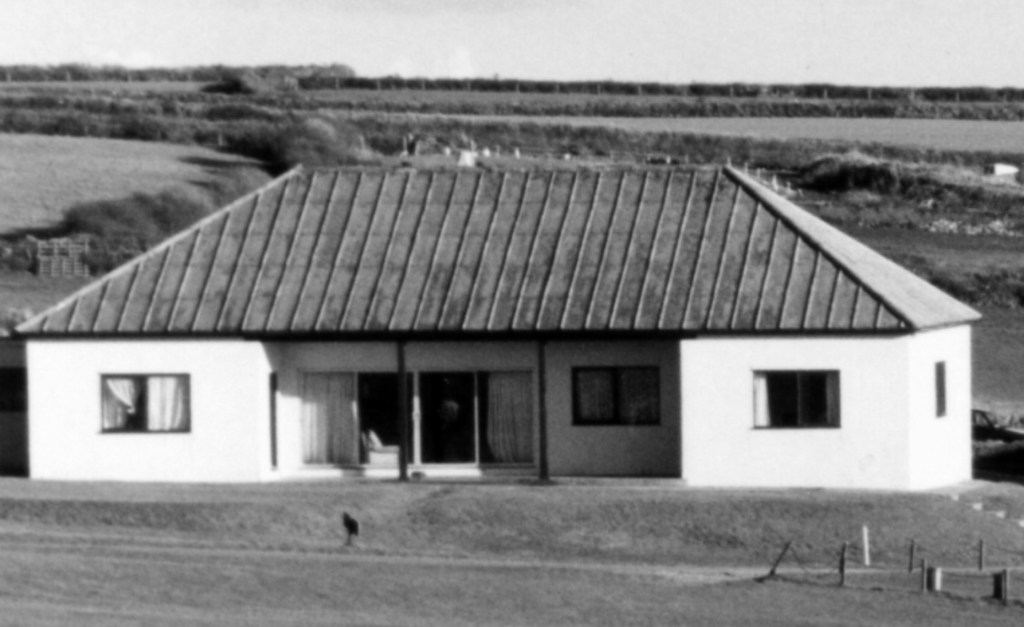
The early histories of both the club of 1927 and the club of 1941 are littered with problems, setbacks and change and now there was to be more of the same. In March 1947 Samuel Goodman, the clubhouse owner and the club’s treasurer, announced his intention to sell the freehold of the building, in fact it was already in the agent’s hands.
His fellow committee members had been looking forward to a period of consolidation but this bombshell took them completely by surprise. Mr Goodman expressed his deep regret at having to sell but said that it was unavoidable. It seems that a prospective purchaser was already lined up, because there was talk of the formation of a country club together with the continued use of the premises by the golf club.
The directors of Perranporth Estates were concerned. The gift of deed included a clause that use of the building was to be restricted to members of the golf club and this ruled out what was being planned. They had considered purchasing it themselves and combining it with the golf course but nothing had come of that.
At this point there was something of an impasse and, with Samuel Goodman unable to extend the terms of use, Perranporth Golf Club offered to buy it. The club was prepared to reimburse Mr Goodman’s original purchase price plus an additional £100 to cover loss of interest on his capital. It soon became clear, however, that this was nowhere near enough; the asking price was well above this figure.
In an attempt to resolve the situation the potential buyer approached Perranporth Estates to ask whether the restrictive clause could be lifted so that the clubhouse could be opened to non-members. This proposition was not dismissed but the directors stated that it would only be accepted if the building remained available as a members’ clubhouse, in other words it could not be used as a general tea-room or club if the golf club vacated it. This strengthened the club’s hand and in June 1947 it was considering whether to begin negotiations with the potential purchasers or to vacate the premises and arrange new quarters in a temporary building.
It seems that Samuel Goodman was negotiating with a Mr Tabb and a Mr Gray, possibly the interested parties from the start. Progress, however, was slow. The uncertainty was not good for morale and in August the honorary secretary wrote to Mr Tabb asking whether they had actually bought the property. It seems that negotiations were still taking place in November but it was not until early 1948 that the club received confirmation that the building could continue to be used as a clubhouse.
The level of rent would remain at £1 a week until the end of April but it would then increase to £150 a year. This three-fold increase was considered excessive and when the club failed to comply, it was served with a notice to move out by the 30th April 1948. Whether this came from Mr Goodman or Mr Tabb is not clear and there is no evidence to suggest that the two potential purchasers ever concluded the deal. Equally, there is nothing to suggest that the club actually vacated the building.
Mrs Doyle was given notice to leave the clubhouse by the 25th March 1948, which may or may not indicate that a new owner was then in place. Certainly in January the following year there were concerns over the sale to an outsider. Not for the first time the directors of Perranporth Golf Club (1941) Ltd were contemplating the closure of the club.
Mr Keymer moved into the clubhouse during March 1949, either as owner or tenant, and announced that he was willing to let the caravan visitors use the bar. This is not surprising as it was clearly beneficial to him to boost his bar takings. Before long a fruit machine appeared and caused some annoyance because it had been introduced with no consultation. The committee felt that as its members would be making the largest contribution the club should receive a share of the profits.
There was consternation when the landlord asked for a further £1 a week in rent and the club responded by saying that it could not see its way clear to paying this. Mr Keymer’s tenure was clearly short-lived and shortly after this we find Charles Archibald Pearce and Victoria Alexandra Mary Pearce in the clubhouse. Within a short period Mr Pearce dropped a bombshell when he announced his intention to raise the clubhouse rent to £550 a year. The “utter impossibility” of paying such a figure was conveyed to Mr Pearce who eventually agreed to leave it unchanged but for only one year. In April 1953 Mr Pearce was still being told that the club could not afford any more than they paid Mr Keymer.
Another problem for Mr Pearce was that he was spending more time than he wished in the bar, particularly in the busy summer months. Because of this he wanted a higher percentage of the bar takings, and in May 1953 he asked for a share of the income from caravan lettings and a share of the subscriptions from temporary non-playing members. Additionally, he wanted the club to provide two hours labour a day for assisting in preparing the bar and dressing rooms in the mornings. He also wanted to see a more determined effort to raise the club’s status during the coming year. This agreement was to terminate on the 31st March 1954, by which date the club was to agree fresh terms or vacate the premises.
The committee was convinced that the club’s share of the bar takings was lower than it should be but, for the moment, that was put to one side as they discussed the revised lease conditions. They determined that in the event of their not being able to agree new terms they would call a special general meeting when the directors of Perranporth Golf Club (1941) Ltd could outline the situation to the members.
In September 1953 Mr Pearce was pressing for the signed lease and the SGM was arranged for the 2nd October. Mr Pearce attended the meeting and provided the bar accounts, which were examined and accepted. He then left while the directors and members discussed what should be done regarding the lease. On his return he was apprised of the club’s financial position and clearly had some sympathy for their situation as he offered to donate one year’s rent as a token of his support. This was gratefully received and, in return, the club agreed to sign the lease for the period to March 1954. This did not, of course, resolve the situation beyond that date.
Two or three weeks later Mr Pearce attended another meeting at which he handed over the bar accounts to the new clubhouse owner, Charles Jones. He also handed over the promised cheque for £52 and left the meeting. This handover is the only clear evidence of a change in ownership since Samuel Goodman bought the building from Service Lumber Ltd. We are left to wonder whether Mr Pearce had become disillusioned with the bureaucracy or whether the venture was not proving to be as lucrative as he had hoped.
Whatever the reason, the clubhouse was now in the hands of Charles and Margaret (Peggy) Jones and, in one of the handbooks, Ray Hartley tells us a little about them. “Charles had retired to Cornwall after a long and successful musical career. He was a distinguished flautist having been 16 years with the original BBC Theatre Orchestra and three years with the BBC Opera Orchestra. Like many musicians, Charles was fond of golf although only playing to a modest 16 handicap (Ray Hartley’s words, not mine). He had been a member of Sudbury Golf Club, Middlesex, since 1929 and took a big interest in the Perranporth Club. He was asked to allow the club to stay and accepted a nominal rent of £50 a year while he paid the rates, heating, lighting, in fact the upkeep of the whole clubhouse himself.
He eventually took over the entire management of the club as honorary secretary and, with the tremendous support given him by the honorary treasurer Ferguson Bown and President J W Godber, he succeeded in establishing a golf club of which Perranporth was justly proud.” According to member John Ball, Peggy also came from the world of entertainment: she had been a Bluebell Girl.
From a letter on the file it would seem that Charles Jones became honorary secretary in 1955; the names of Dr Robb and C A S Creeper have been crossed through, suggesting that they had been joint secretaries prior to him.
In March 1948 a good servant was leaving. The donkey, together with its cart and harness, was for sale, presumably because of the onset of mechanisation.
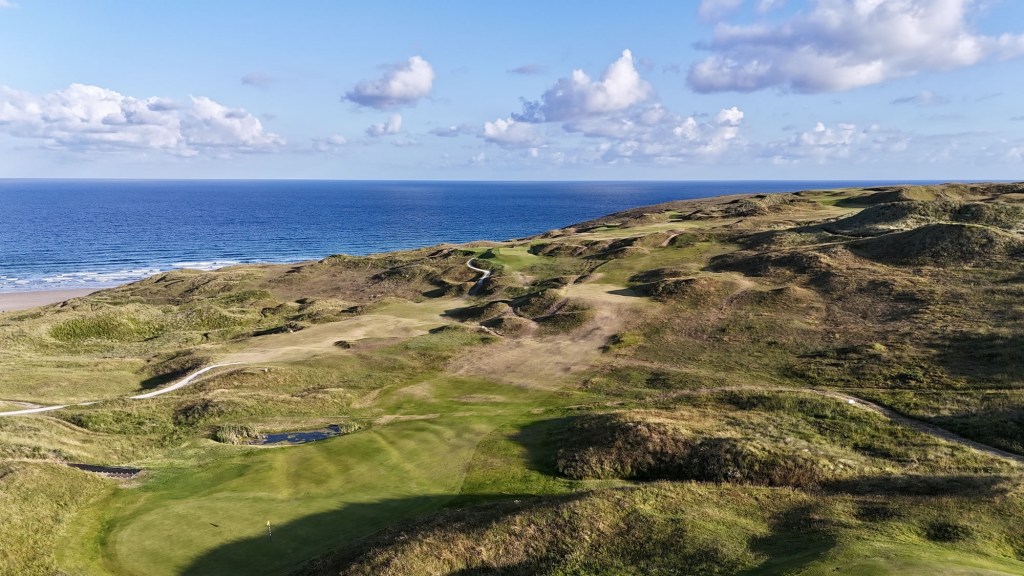
At the AGM in May 1950 the new club had been in existence for about ten years but it was important not to relax the hand on the financial tiller. The captain felt that good progress had been made but stressed that more help was needed if Perranporth wished to keep the golf club in existence. Once again, there was a call to revive the ladies’ section and also to make every effort to increase the number of junior players, the future of the club.
Perhaps the warning had not been heeded or maybe events had conspired against the club but in late 1953 Mr Clark of Perranporth Estates was asked whether he would accept £80 for the rent because if the full amount were demanded it would mean that the club would have to close. Fortunately he was sympathetic and readily agreed. It is difficult to perceive Mr Clark as anything other than a very tolerant man.
To provide a little extra income it was suggested that a ball-machine should be installed in the bar and that the hotel scheme be extended, an arrangement that had been running for some time and allowed hotels to have corporate membership on behalf of their guests.
In March 1954 the finances were showing signs of improvement and with the immediate future secure, the captain repeated the appeal to the ladies to appoint officers and, once again, become a live section of the club.
The Ladies’ Section
The ladies’ section was formed in June 1927, a month after the grand opening, but following the demise of the first club and the subsequent creation of Perranporth Golf Club (1941) Ltd there seemed to be a reluctance to re-invent itself. It took 17 years, and whilst we are sure that there were ladies playing during that period, it was not until 1958 that a ladies’ captain was in place once again. It was Clarinda Letcher, a lady who was over 100 years old when she died and who had considerable input to club activities. Since her time the ladies have continued to be fully involved in the life of the club.
Conclusion but not the End
So ends the book but not the story of Perranporth Golf Club, which continues to grow and create history. A club which began back in 1926, failed in 1940 because of financial problems but reinvented itself just a few months later to grow into the thriving organisation we see today. Inevitably more information will now be found – it always happens following publication – and my hope is that it will be safely stored until the time comes for someone to write the sequel.
Author Profile
Tony Mansell is the author of several books on aspects of Cornish history. He was made a Bardh Kernow (Cornish Bard) for his writing and research, taking the name of Skrifer Istori. He is a sub-editor with Cornish Story and a researcher with the Cornish National Music Archive specialising in Cornish Brass Bands and their music.
The story above draws on contemporary newspapers, club records, and the research of Tony Mansell. The following notes acknowledge those sources.
Tony Mansell’s Acknowledgements
My thanks go to many people who have helped produce this book.
To the long list of people who agreed to be interviewed and have contributed information and photographs: Peter Andrews, Norman Armstrong, John Ball, Peter Boeck, Steve Brooking, Bill & Vicky Comyn, the Cornish Language Partnership, David Crossley, David Duckham, Martin Edwards, Len Farnworth, Russell Fowler, David Goody, Keith Gray, Alan Greenland, Ted Gundry, Viv Hill, Chris Jeffery, Terry Lewis, Mike Male, John Massey, Ian McKechnie, Stewart McKechnie, Derek Michell, Trevor Miners, Alan Mitchell, Bill Mitchell, John Mitchell, Trixie Mitchell, David Nicholson, Margaret Oliver, Richard & Sally Pearce, Jenny Potter, Tony Reynolds, Fred Roberts, Jan Sargeant, Malcolm Seaton, Mike Sharp, David Short, Gerald Simmons, Peter Sugden, John Thomas, Richard Todd & Bart Welch.
To the authors and photographers who have contributed to the Official Handbooks across the years.
To Steve Brooking, Keith Gray, Vicky Lee-Comyn, John Thomas, John Varcoe and the late Peter Barnes for the use of their many photographs.
To Bill Comyn for financial data.
To Perranzabuloe Museum for access to minute books and other information pertaining to the club.
To the Royal Institution of Cornwall (Truro Museum) for providing access to its photographic library.
To Keith Martin of G C Davies, Solicitors, who, with the permission of the golf club, provided access to the golf course deeds and other documents.
To Margaret Oliver, Vicky Lee-Comyn, Jan Sargeant, Jenny Potter and Martin Edwards for reviewing sections of the book and to Richard Pearce and David Mugford who not only managed to wade through the lot but also suggested many modifications which improved the finished article.
To Peter (Nick) Thomas for his (very) necessary proofreading.
Finally, and in particular, to David Mugford who has been tireless in providing information and answering my many, many questions.
Trelease Publications
Copyright © Tony Mansell 2014, All rights reserved
First Published March 2014
No part of this book may be reproduced without permission from the publisher
References
Perranporth Golf Club minute books 1926-1957 and 1985-2013
Perranporth Golf Club AGM information
Perranporth Golf Club year books
Deeds and documents pertaining to legal aspects of the club
West Briton
Books written by Tony Mansell
Mithian in the Parishes of St Agnes and Perranzabuloe
St Agnes and its Band
With St Agnes in Mind
Camborne Town Band
St Agnes Golf Society
Camborne Town Band – the continuing story
Marching to a Different Drum
Tony Mansell with Clive Benney
A History of Blackwater and its Neighbours
Jericho to Cligga
Our Village Church
Memories of Mount Hawke
I rode to St Agnes
Cornish Golfer Credits, Bibliography, Acknowledgements and Thanks
Opening image — Holiday Golf on the Cornish Coast – The Fifteenth Green at Perranporth. Photo Credit: Golf Chronicle/Lee Patterson
A Century on the Towans, Hugh Harvey and Ernie Symons
James Braid and his Four Hundred Golf Courses, John Moreton and Iain Cumming
The Divine Fury of James Braid, George Payne
Shaun Davies, Golf Classics
Copyright © Mike Roberts, Cornish Golfer
 Cornish Golfer