
What a year it has been for Harry Hall.
Over four million dollars in season winnings on the US Tour, seventeenth place in the FedEx Cup standings, sixth in Stroke Average, number one in Putting Average, seventeen straight cuts made on Tour (with only four players ahead of him on the cut-streak list).
No wonder the Cornish want to put him on top of Brown Willy and place a crown on his head.
His achievements in 2025 made big waves back home. Friends, family and golfing mates on the Lelant Towans at West Cornwall Golf Club track every shot of every tournament he plays — on Sky TV when he’s shown, and on ShotLink on the PGA Tour website when he’s not. Following Harry’s progress in 2025 has been a joy to behold.
A prophecy
It was the year before when the seeds were sown — words of prophecy, even.
In the first week of May, after shooting 71 and 66 at the CJ Cup Byron Nelson for a five-under, two-round total — cruelly one shot outside the cut line — Harry wrote:
“Tough times continuing on the course at the moment. Nearly made the cut last week after birdieing four of the last five holes, thinking ‘unlimited patience brings endless opportunity’. That mindset kept me with a chance to play the weekend last week, and it makes anything possible. Could keep me with a chance to make the cut again this week, win this season or have a putt to make East Lake.”
The following week at Myrtle Beach, Harry made the cut by one shot inside the number, and within two months had his first win on the PGA Tour. The ‘putt to make East Lake’ had to wait another year, but the prophecy was made and the dream was on.
Season start
2025 kicked off with a big-bucks Signature Event, The Sentry. Prize money at these events is huge, and a top-ten finish secures both gold and valuable FedEx Cup points. Harry played in three of the eight Signature Events in 2025 and bagged rich pickings at two of them.
The opener brought a T8 finish and $550,000. January continued positively and he finished the month ranked twenty-third in the FedEx standings.
Shaken but not stirred
In keeping with his 007 James Bond idol, a run of three missed cuts in the next four events provided some weekends off to lay the foundations for a remarkable year — one that, if you were not looking closely, might have appeared to come about through unchanged application.
As it was, Harry was moving to another level.
Ball change
Then came the move to Bridgestone, the ball used by Tiger. It was an incredibly brave choice. It took a week or two to adjust, particularly in the winds of the February West Coast swing, but it putted beautifully.
Whether it was responsible for turning one of the best putters in the world into the best putter in the world is open to debate. What is beyond doubt is Harry’s right to claim that title, or at least a share of it.

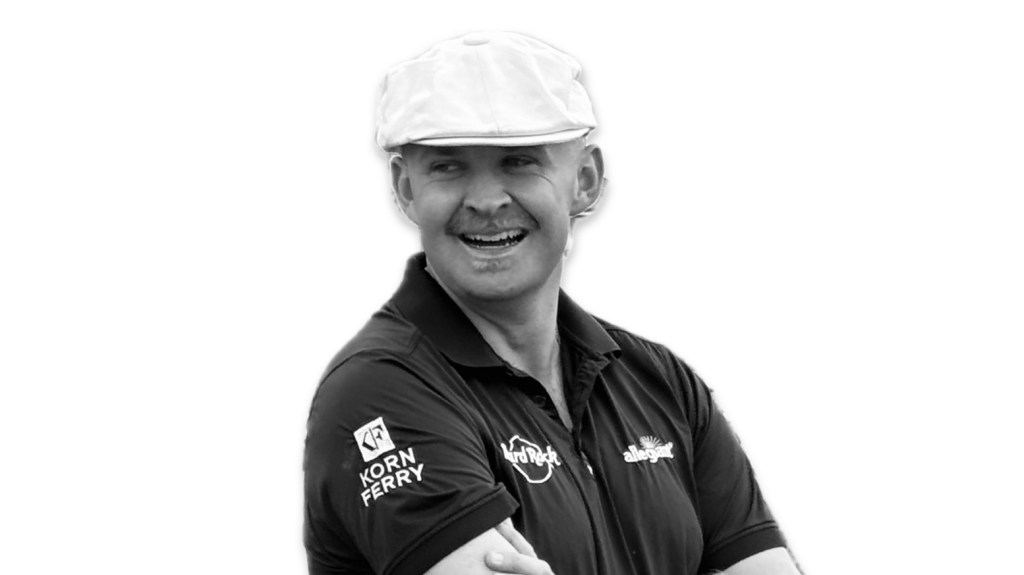
Another benefit of the move was the freedom to wear his Cornish flat cap in the way that Jim Barnes and his grandfather had worn it — free from any sponsor’s logo. The chevron had gone. Noticeably, Harry began to wear an array of new cap styles and colours, matching his growing confidence on the course.
Not much else changed outwardly. The same shirt sponsors, Hard Rock and Allegiant, remained, set against his Cornish-themed palette of black and gold — along with the black-and-gold striped tee pegs, the lion driver cover and the four-leaf-clover putter cover.
A champion’s routine
In another radical change early in the season, Harry adopted a new addition to his pre-shot routine. Identifying perhaps one factor that makes Scottie Scheffler such a consistent ball-striker, Harry copied Scheffler’s ingrained habit of taking his grip and checking it before walking into the ball — never adjusting the grip once set at address.
“It’s hard,” said Harry. “I’m still getting used to it — you wouldn’t believe how hard it is!”
We believe you, Harry.
A new coach
Butch Harmon. We love Butch in Cornwall — we would surely adopt him if he came to visit. It was no surprise when Harry picked the best.
One can only imagine the stories of Tiger and Adam that Butch might regale in the swing studio, some repeatable, some not. Besides, he’s the coach to Tommy Fleetwood.
“He’s a better man than he is a golfer,” says Butch. What greater reference could you get?
A trip to Montana
It’s a long way to go — to Big Sky Country — but if a trip is worth making, it is worth making properly. Cornish miners settled there in the nineteenth century; Jim Barnes honed his game there in the early twentieth. Another English golfing hero lives there now — Sir Nick Faldo.
Six-time major champion. Three Masters. Three Open Championships.
Who better to consult?
Harry went the extra mile. He prospered.
A successful caddie partnership
Midway through 2025, Harry switched caddies to experienced bag-man Henry Diana, a former tour professional on the Nike Tour. In their first four events together, Harry and Henry finished no worse than tied twenty-fourth. The run would continue.
From the beginning of May, Harry was on fire. His finishes included a top-twenty in his first PGA Championship and a T6 in the Charles Schwab.
June ended with two important tournaments for Harry: the Travelers Championship — a Signature Event — and the Rocket Classic in Detroit.
At the Travelers, where several players withdrew with a sickness bug, Harry pulled himself out of a medical truck just before the third round. Undergoing multiple IVs and without a warm-up, he made the first tee and somehow got around in 69. Feeling a little better on the final day, he shot 65, climbed seventeen places, secured a top ten and collected a $540,000 cheque.
Worth getting out of bed for.
At Detroit, he finished at eighteen under par — he had not shot a round over 70 for a month — for T13, moving himself to forty-sixth in the FedEx Cup race.
Home for the Open Championship
Whatever the success in America, it was back home where the Cornish wanted to see their boy. In early July, they got their wish.
Harry rushed to the airport after Detroit and caught an earlier flight. His father picked him up in England, and they headed straight for Open Qualifying at Burnham & Berrow. Without a practice round, and with his boyhood friend on the bag, he got the job done over thirty-six holes.
Interviewed by John Morgan on Sky Sports after finishing his rounds — in accents that made it sound like a West Country bro-fest — Harry said the course suited his eye, and that he had gone with driver on every hole.
He was six under after nine holes in the first round. Then trouble arrived. Adopting greater caution, he made it through with room to spare.
“Now that I’m in the Open,” he said, “I think my wife and daughter will come across.” That they did.
He finished the interview by saying he was off to buy a drink for anyone from Cornwall who had travelled up to Somerset.
A hundred-year moment
In an article published in the Global Golf Post in July titled ‘Too few pay mind to golf’s history’, Lewine Mair highlighted the lack of interest shown by many modern professionals in the game’s past. There were, she noted, exceptions — among them Harry.
“England’s Harry Hall is also worth a mention. He is a 27-year-old member of the present generation who has been drawn to the past via the story wrapped in his flat cap… when people kept asking about it, he decided to include ‘Long Jim’ Barnes in the story by way of adding a bit of interest to his own profile… his achievements in winning all the majors other than the Masters in the early 20th century had been Harry’s source of inspiration.”
In keeping with Mair’s observation, straight after qualifying for the Open, Harry played in a celebration match for his home club West Cornwall Golf Club against Prestwick Golf Club at Prestwick, to honour Jim Barnes’ Open victory in 1925.
At Prestwick, Harry partnered Phil Rowe in a Ryder Cup-styled fourball match that kicked off the proceedings, culminating in a win for West Cornwall and for Hall and Rowe.

Ryder Cup speculation
It was at a time when speculation grew as to whether Harry Hall might receive a Ryder Cup pick.
“It would be massive,” Harry said. “I remember growing up, and Phil Rowe, my assistant coach in college, was my idol. He played in the Walker Cup in 1999. We have his bag in the clubhouse.
“And people always used to say, ‘H, are you going to put a Walker Cup bag up there one day?’ And I always said, ‘A Ryder Cup one.’”
The Scottish Open
Leaving Prestwick on the Sunday with his wife and daughter now across from America, Harry headed to East Lothian to prepare for the Scottish Open. The acclimatisation paid off and, after finding himself in the final pairing on Saturday alongside eventual winner Chris Gotterup, he finished with a top-twenty and ready for The Open.
The Open
Harry’s first Open Championship lived up to expectations. After a 4–8–4 start that left him four over par after three holes of round one, he was always playing catch-up and did well to close the gap.
In the final round, paired with Justin Rose and approaching the last three holes at seven under par in twelfth place, a strong finish beckoned. The closing stretch is notoriously difficult, beginning with the sixteenth — Calamity Corner.
From the tee, the hole had captured Scottie Scheffler’s imagination.
“It’s one of the coolest views that I’ve seen in the game of golf,” he said. Asked after his maiden Open victory whether he was disappointed to make only par on the final day, having birdied it in each of the first three rounds, Scheffler replied: “I was fortunate to be able to enjoy the walk with a putter versus having to go down there into the ravine and try to hit a wedge out.”
No such luck for Harry. His tee shot slipped off the side of the green and down into the chasm. Standing precariously, he did not appear fazed. He had played the shot before — growing up at Lelant, over the side of the ninth or through the back of the second, countless times as a boy. He blasted the ball high into the air, landing it to around eight feet, then calmly holed the putt for three.
As Sky commentators speculated about a potential Ryder Cup pairing with Justin Rose, Harry walked on.
But his luck turned on the closing two holes. At seventeen, he drove the ball fully 398 yards, reaching the green of the par four. The ball trickled sideways into a bunker. Two closing bogeys dropped him back from a possible top ten.
Calamity had struck after all.
Still, it was a top-thirty finish in his first Open. He also tied Scottie Scheffler at the top of the Total Birdies table, with twenty-one apiece.
Back to America
August brought the FedEx Playoffs. Three weeks of whittling the field from seventy at St Jude, to fifty at the BMW Championship, and finally the top thirty at the Tour Championship at East Lake. Getting to East Lake is the pinnacle for a season’s golf on the PGA Tour.
Harry arrived at St Jude ranked forty-fourth, knowing that a strong week was required. His chances of staying inside the top fifty looked slim after three straight bogeys before the turn in the final round, a run that briefly dropped him outside the number. But he rallied on the back nine with four birdies, signing for a 69 and a tied twenty-second finish — just enough.
That result moved him on to the BMW Championship the following week, still forty-sixth in the standings and with further work to do. To reach East Lake, he needed to climb inside the top thirty.
The prize was guaranteed entry into all Signature Events on the PGA Tour in 2026. A private equity investment and the continuing fallout from LIV meant the Tour was becoming more exclusive, as fast-sliding doors closed in front of players’ faces.
Needing two pars to secure his place, Harry produced an “in-your-life” moment — a pitch landing perfectly at the top of the slope and trickling down into the hole, the Bridgestone logo hovering briefly where a Nike swoosh once had. A fist-pumping celebration followed.
“I had practised that chip more than anything else all week,” he said afterwards.
At the final hole, a safety-first approach left a short putt — just three feet — to fulfil the prophecy. It was confidently holed.
It took a sixth-place finish, earning $750,000, to make it happen. Harry was the only player who began the week outside the top thirty to progress.
At the Tour Championship itself, Harry again impressed. On a course newer to him than to most in the field, he more than held his own.
Paired with Rory McIlroy for the first time on the PGA Tour in the final round, Harry started slowly, two over after five holes, before reeling off six birdies. A closing 66 saw him finish T17, four shots better than McIlroy that day.
Rory McIlroy, Justin Rose, Shane Lowry and Harry lingered by the eighteenth green to usher Tommy Fleetwood home as he completed a hugely popular Tour Championship victory and collected the $10 million first prize.
Harry later posted on Instagram about how much he had enjoyed playing with Rory.
It recalled Scottie Scheffler’s account of playing his one and only round with Tiger Woods, a moment that had left a lasting impression. Harry will surely play many more with Rory, but that time at East Lake will have stayed with him.
Back home
The PGA Tour season was over. Week after week, under intense pressure on unfamiliar courses, alongside the game’s leading figures, Harry had met every challenge.
The European swing followed: Wentworth, St Andrews and Paris. The pace eased. Time with family returned. A week or two back home in Hayle followed. As always, he was at West Cornwall Golf Club, helping with junior coaching.
Cornish fans travelled to watch him. At Wentworth, he was paired in the opening round with Francesco ‘Dodo’ Molinari, Luke Donald’s right-hand man and Ryder Cup vice-captain.
It was clear now that Harry would not be a Ryder Cup pick this year. Others had cemented their places and, looking back, who could deny Luke Donald’s choices? Later, Harry enjoyed a strong third round alongside Adam Scott — two of Butch’s players together.
By the end of the week, a thirteenth-place finish had carried Harry into the world’s top fifty on the OWGR.

On arrival at Wentworth, Harry sought out the painting in the clubhouse of Jim Barnes striking the opening shot of the 1926 Ryder Cup, later struck from the record books. Wentworth will no doubt make much of the centenary in 2026 as ‘Where the Ryder Cup Was Born’.
At St Andrews, with boyhood friend Matt Richards on the bag, Harry found himself on the wrong side of the draw in a weather-affected Dunhill Championship. In France, with Ryder Cup incentives gone, there was less at stake, but it provided an opportunity to catch up with Fanny Sunesson — another anchor to the past.
2026 holds great promise. Entry into every Signature Event, as well as all the major championships.
And what of that prophecy? The one written a year earlier, when times were hard, patience was tested, and the dream was simply “to have a putt to make East Lake”?
It ended like this:
“Hopefully a green jacket one day. I’ve been in positions like this before in my (still early) career, and I know all that matters is perfecting the process, growing as a player and leaning on the things in life that bring you joy.”
You take all the time in the world, Harry.
Cornwall will be watching.



 Cornish Golfer